Cape Town – Pupils forced to write their matric exams in languages other than their mother tongue are put at a distinct disadvantage, leading to lower scores on their papers, according to UWC’s linguistics department head.
Professor Bassey Antia said the Department of Basic Education (DBE) should invest in more teachers, moderators and invigilators who speak African languages in order to administer examinations across more diverse languages than just English and Afrikaans.
“In classrooms, learners are often taught in more than one language.
“It is therefore somewhat unnatural for such learners to be tested in only one of these languages, especially when it is the weaker of their languages,” he said.
“Speakers of African languages, in particular, score the lowest since their languages are not used in examining content subjects.
“The language of the exam paper itself should not be a challenge; the content of the paper should.
“When results are released everybody says the performance is dismal and the language question tends to be dismissed.
“I say we should look at it differently, because the environments are multilingual and learners acquire knowledge across languages. However, when it comes to assessment, learners are tested in one language, the official language.”
The DBE said it does not have enough teachers to teach indigenous languages and therefore cannot administer exams in African languages.
Department spokesperson, Elijah Mhlanga said the DBE embarked on an initiative aimed at bringing indigenous African languages into mainstream education, but it has yet to bear fruit.
“We implemented the Incremental Introduction of African Languages policy in 2014 which was aimed at forcing all schools in South Africa to offer at least one African language.
“At the end of the pilot we learned there was a shortage of teachers in this area.
“We have started to attract teachers using a variety of measures aimed at increasing the numbers and thus grow African languages in our schools.
“As things stand, we don’t have enough people that work in this area of our system and that is what we need to do first before we can administer exams in African languages.”
Antia conducted a study which found students who registered to write matric in English and who know both matric exam languages (English and Afrikaans) would flip their exam papers over to read the Afrikaans side if they did not understand the term in English, and vice-versa.
His study, which started in 2013 and is ongoing, includes 119 students from different language groups.
“Terms in one language can be more descriptive than in another language,” said Antia.
“There is knowledge embedded in terms.
“Knowing several languages can afford different entry points to understanding.”
Antia hopes to present his research to the DBE once it has been published.
“If I was personally committed to enforcing decolonisation, science as a whole is a product of western modernity and the whole thing should be scratched off.
“If you want practical solutions to decolonise science, we would have to restart science from an African perspective; from our perspective of how we’ve experienced science.”
These are quotes from a student attending a University of Cape Town (UCT) Science Faculty meeting with members of the ‘Fallist’ movement on 12 October. #ScienceMustFall began trending on 14 October, after a YouTube video from the meeting went viral and was ridiculed on social media.
The member of the ‘Fallist’ movement continues by describing how rural people in KwaZulu-Natal believe that black magic can be used to “send a lightning” to strike someone. She asked the audience to explain that scientifically, but this was met by laughter.
Decolonised education is a phrase that has been bandied about recently by students, but what does this actually mean? What does a decolonised university look like?
What is decolonised education?
Tabisa Raziya (22), a Bachelor of Social Science student at UCT and former #FeesMustFall member, believes that decolonising education is taking everything as it stands, the curriculum, culture and institutional values of education, and changing the face of it.
“It’s about restructuring the way it’s taught, what we’re taught and who we’re taught by.
“Decolonisation means making education more Pan-Africanist. So, the ideals of afro-centrism are promoted in the curricula and academics of colour become heads of departments and vice-chancellors.”
Raziya explains that decolonising education means reflecting a post-colonial intellectual space instead of one that reflects western and colonial values. She believes it should reflect the current demographic in South Africa.
A statement, released by the Fees Must Fall movement on 26 October, said that #FeesMustFall is a demand for “a free decolonised, Afro-centric education”. “This call is rooted in the liberation of black people and the total dismantling of the anti-black system that maintains black oppression.
“Fees Must Fall is an intersectional movement within the black community that aims to bring about a decolonised education. This means that the Fees Must Fall movement is located as a part of the larger struggle to eradicate the western imperialist, colonial, capitalist patriarchal culture.”
According to Athabile Nonxuba, a UCT student who spoke to News24, decolonisation includes the development of African interests, rather than Eurocentric ones, and an African education. “Eurocentrism does not serve our interests culturally, socially, economically. It does not resolve the issues of Africa.”
Nonxuba explains that decolonised education can only be introduced if the current system is overthrown and the people it is supposed to serve define it for themselves. “We want to review the system and curriculum, and that can’t happen without a decolonised institution.”
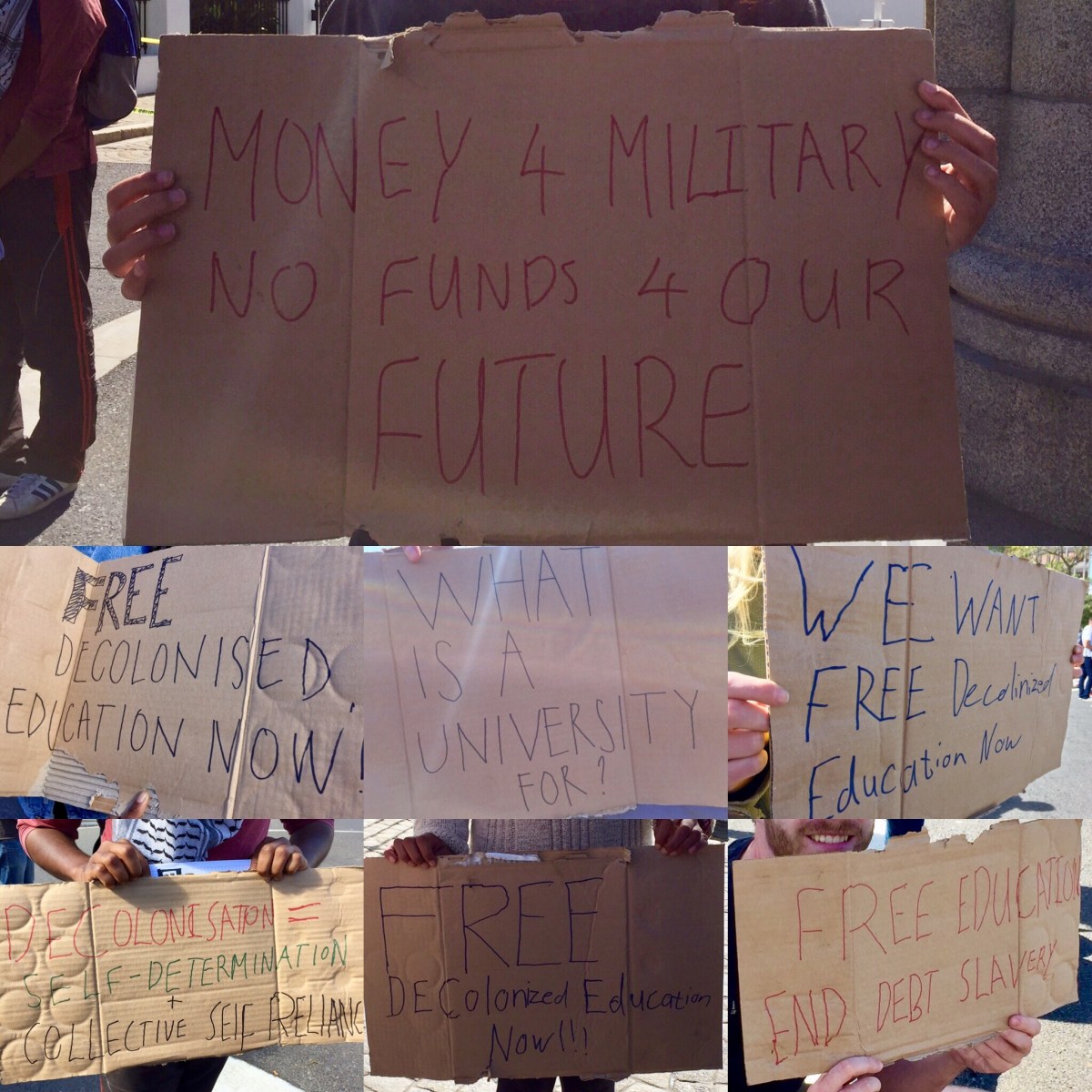
PHOTOS: Students gathered outside of Parliament on 7 October 2016 to hand out pamphlets to passers-by. They hoped to further and deepen the debate on the possible next steps for the free education movement by engaging with passers-by. All photos by Saarah Survé.
Students gathered outside of Parliament on 7 October 2016 to hand out pamphlets. They hoped to further and deepen the debate on the possible next steps for the free education movement by engaging passers-by. PHOTO: Saarah Survé
A UCT student holds a sign which says “Money for military. No funds for our future”. She was standing outside of Parliament hoping to engage passers-by to further and deepen the debate on free education. PHOTO: Saarah Survé
A UCT student holds a sign calling for “free decolonised education now”. She was standing outside of Parliament hoping to engage passers-by to further and deepen the debate on free education. PHOTO: Saarah Survé
A UCT student holds a sign calling for “free decolonised education now”. She was standing outside of Parliament, with other students, hoping to engage passers-by to further and deepen the debate on free education. PHOTO: Saarah Survé
A UCT student holds a sign calling for “free decolonised education now”. She was standing outside of Parliament, with other students, hoping to engage passers-by to further and deepen the debate on free education. PHOTO: Saarah Survé
A UCT student holds a sign which says “Free education. End debt slavery”. He was sitting outside of Parliament hoping to engage passers-by to further and deepen the debate on free education. PHOTO: Saarah Survé
A police officer looks down at a sign that a UCT student is holding, outside of Parliament, on 7 October. The sign reads: Free education. End debt slavery. He was hoping to engage passers-by to further and deepen the debate on free education. PHOTO: Saarah Survé
What does colonised education look like?
Raziya recalls sitting in a politics class at UCT in her first year. “I’d never read any of the articles in my course reader before. They were written in Old English and jargon. It did not reflect the politics of the time and I felt that the opinions were based on western ideas of politics.
“Politics is such a pivotal subject in terms of contributing knowledge. That was the first time I felt that even though I went to a Model C school, English was my downfall, because I couldn’t agree with the arguments when I knew that they were anti my belief system.”
Nonxuba explains that students are not introduced to new ideas by Africans, but instead the work of Europeans is offered as a standard in the classroom.
Nonxuba believes that black students are dehumanised by the current curriculum. “We study all these dead white men who presided over our oppression, and we are made to use their thinking as a standard and as a point of departure.”
Suellen Shay, dean and associate professor at UCT, agrees that this is one of the fears of the decolonising movement. “Curriculum content is dominated by – to name some – white, male, western, capitalist, heterosexual, European worldviews.
“This means the content under-represents and undervalues the perspectives, experiences, epistemologies of those who do not fit into these mainstream categories.”
Raziya agrees that the space wasn’t provided to talk about topics such as politics, race, rape, gender and sexuality outside of the media studies department’s hetero-normative and western frameworks.
“If we spoke up, the lecturers and tutors would pull us aside and tell us we were making noise. The one narrative that was given was not open for discussion.
“I felt that they were silencing black and queer voices and anything counter-argument to this idea that everything is fine and that we should all just be grateful that we are at UCT.
“UCT is suffocating, because I feel I have to leave a part of me at home just to be taken seriously. I have to speak more English than Xhosa in order to survive.”
Shay says that despite all of the talk about decolonising the curriculum, there has been little change, but that this is understandable. “Statues fall, fees fall, but curricula don’t ‘fall’,” she explains.
According to Shay, the risk of not having a clear strategy on how to decolonise education is that “the curriculum will look no different in 2020 than it does in 2016”.
VIDEO: On 7 November 2016 students hosted a #FeesMustFall Poetry Evening in Cape Town. It was a space to share poems, music and thoughts. See a video of the event below.



 Saarah Survé