Majuba prim sees change in residence’s attitude

6 April 2016

Saarah Survé, Stellenbosch Department of Journalism

Stellenbosch University – Irene primaria, Lize-Mari Doubell, and Majuba primarius, Hein Stegmann, have collaborated to change male students’ perceptions of females, after degrading posters were placed around Majuba residence last week.

A first-year student on Majuba’s social committee put up degrading posters advertising a social event with the women’s residence, Irene. Doubell, head of the women empowerment task team, was notified and immediately cancelled the social.

“We had to think carefully about our next move,” said Doubell. “Reporting a residence to the university’s Equality Unit is the normal route that is taken when there is a case of discrimination, gender inequality or objectification, but we wanted to engage with Majuba.”

Doubell explained that Irene did not want to take disciplinary action, because behaviours would not have changed through disciplinary action alone. “All that Majuba would have to do is tick the boxes; apologise, appear before the committees and panels and be banned from a social event.”

“We decided to work with Majuba to combat rape culture and the objectification of women. For first-year students to think that it is okay to make degrading posters about women, speaks to a greater culture of what residences and men allow. Residences are normalising the objectification of women,” said Doubell.

Doubell said she told Majuba’s house committee members that Irene wanted to see tangible change take place in Majuba’s culture. “It’s about more than one poster; it’s about changing the culture of men’s residences on campus, and creating a positive impact.”

Stegmann said that Irene’s decision not to report them has been a massive blessing. “When you are reported, it feels like all you are trying to do is defend yourself. You start in a defensive mind-set. But as soon as someone is willing to work with you, you know that their intentions are good.”

Stegmann said it has been a whirlwind week for Majuba with many conversations, group discussions, education and progression.

“In my four years in Majuba, we have never had critical discussions about women empowerment and gender equality.

“First the guys said that maybe Irene was too sensitive, but then they started asking questions; how do we feel, is it offensive, and what is the problem,” said Stegmann.

“I saw them click. They realised they have to change. This situation has been a call for not only Majuba men to step up, but all men,” said Stegmann. “It is a dark cloud with a silver lining. It’s our image that is being made an example of, but in the long run, it’s for the good.”

The two residences had an optional rape culture talk on Tuesday night, with about 90 Majuba men out of 150 present. Doubell said it was evident that rape culture was a new concept for a lot of them.

“There was a lack of understanding, and it is clear that there is a gap in men’s education.”

However, Doubell said that the men were open to the idea. “They didn’t take a defensive stance. They are tackling the issue head-on, and I think that’s what will make a huge difference.”

Doubell said that there is still a lot of work to be done on both sides. They have asked Majuba to consider being the first men’s residence on campus to have a women empowerment portfolio on their house committee.

Next on their agenda is a meeting with the heads of all 44 residences and private student organisations.

SU students go wild for natural medicine

30 March 2016

Saarah Survé, Stellenbosch Department of Journalism

Stellenbosch – KeenMind, a natural alternative to medications like Concerta and Ritalin, is flying off the shelves at the Eikestad Mall pharmacy in Stellenbosch, according to Michael du Preez, who supervises the pharmacy’s vitamin laboratory.

KeenMind claims to improve mental performance.

“It is our biggest seller at the moment as more students move towards a more natural option. We recommend it, because students don’t need a script to buy it and it doesn’t cause a crash, like Concerta and Ritalin, which you do need a script for,” said Du Preez, a biochemist.

Du Preez advised students to skip a weekend of partying and invest in their health instead, which will in turn benefit their education, as they will be able to concentrate better.

“In relative terms, these supplements are not expensive; R205 to R250 for a month’s supply is a tiny price to pay for delayed gratification.”

Du Preez said that KeenMind can work as quickly as three to four days. He added that no serious side effects have been recorded.

Du Preez has first-hand experience with Ritalin, as he was prescribed the drug at age 13. He says that it changed his character. “You become subdued. It’s like a tranquiliser.”

Similarly, Jacques Booyens, a Stellenbosch University (SU) graduate, began using Ritalin at the age of eight. He stopped this year and is studying for the first time without any medication.

Booyens admitted to trying a few natural products for focus, but felt like a lot of them were “just snake oil.”

De-Ann Snyders, a Stellenbosch student in industrial engineering, was also diagnosed with ADD and has been on Concerta for two years.

Snyders said that she tried Bio-Strath, a daily herbal nutritional supplement, but that taking the medication became too much administration for someone with ADD. “It took four days to get into my system and I had to take six pills a day. As someone with ADD, I don’t understand why people want this drug so much.”

“It’s also expensive (about R460 for 300 tablets) and made me very agitated. I felt like a zombie,” said Snyders. “If you don’t need it, stay away. It will help anyone concentrate better, but once you realize that it helps, it can become addictive,” she warned.

Du Preez said that it is important for students to know that there are natural options available, like KeenMind, which doesn’t have negative side effects. He asked students to consider these before they take other medications, such as Ritalin and Concerta.

Theatre transports children to magical place

‘Children believe in what you create on stage’

10 March 2016

Saarah Survé, Stellenbosch Department of Journalism

Weltevreden Wine Estate – “When adults see a production, it influences them and they talk about it. But when a child sees one, their whole world changes. You transport them to a magical place.”

Margit Meyer-Rödenbeck, known for her characters Dowwe Dolla and Liewe Heksie, believes that there is magic in children experiencing and engaging with theatre.

“Children believe what you create on stage, as opposed to adults, who create boundaries around themselves. So, it’s wonderful to create and work for children,” said Meyer-Rödenbeck.

File_000
Dean Balie (Watson) and Sne Dladla (Florence) in Florence and Watson and the Sugarbush Mouse PHOTO: Saarah Survé

She explained that in a children’s theatre production, they coax children into engaging by asking them questions, so that they become the problem solvers or another part of the production.

“Children watch TV and computer screens all the time, but that doesn’t teach them to engage.”

She is worried that if we do not continue to educate children in the theatre, we will lose the future generation.

“In this country, I can’t emphasise enough how important it is to get kids into the theatre and make them theatre-goers,” Meyer-Rödenbeck said.

Hanli Brink, Managing Director of Lollos Productions, agrees that there is a definite need for children’s theatre in South Africa.

Lollos is an Afrikaans edutainment show for children, and there will soon be an English version.

“You can watch Barney, but kids can relate more to South African shows where you teach them about our country and facts like the names of the provinces,” says Brink.

“We’ll teach children about eating healthy, but it will be through a song or a dance or another fun way. We have one song called smarties and tamaties, and it says eat your tamaties before you eat your smarties. It’s catchy, so it sticks in their heads. It’s education, but in a fun, memorable way,” said Brink.

Solms-Delta community gets a voice

8 March 2016

Saarah Survé, Stellenbosch Department of Journalism

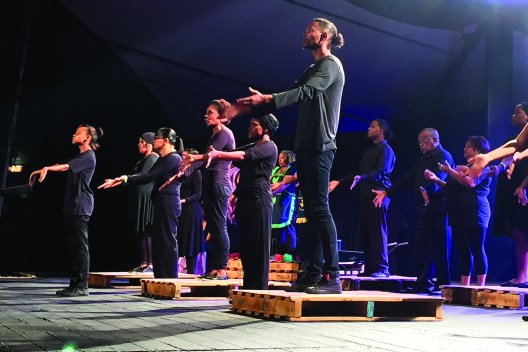
Spier Amphitheatre – The aim of the musical Philida van de Delta is to give a voice to the voiceless and to hear their stories through song.

Philida van de Delta 2
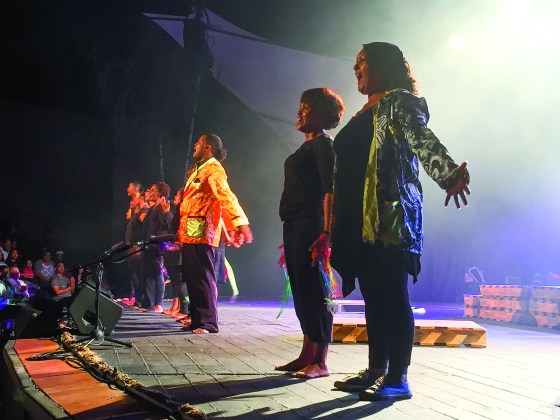
The Delta Soetstemme   PHOTO: Saarah Survé

Organisers of this musical therefore invited members of the Solms-Delta community to take part, giving them a voice in the show.

“Everybody who arrived was allowed to be in the show. Nobody had acted before, but they chose their roles,” said Adriaan Brand, project manager of the Music van de Caab Heritage development. Brand compiled and adapted the story to music. He is also a founding member of the Springbok Nude Girls.

Philida van de Delta
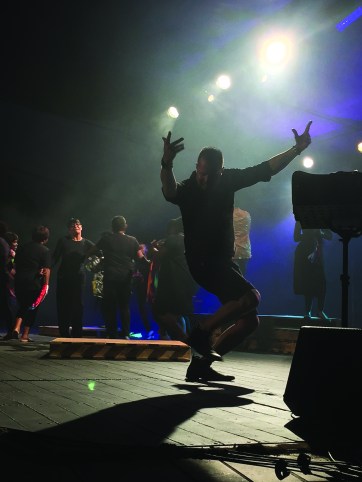
Adriaan Brand having fun on stage  PHOTO: Saarah Survé

Solms-Delta and members of Babylonstoren guest farm and the multidisciplinary cultural Breytenbach Centre collaborated to present Philida van de Delta.

The musical was inspired by historic documents, their own imagination and the late André Brink’s novel, Philida.

“They read Philida, the historical records and had their own ideas. They told their neighbours the story and we actualised their telling of the story,” said Brand. “We gave them complete freedom to express their voices, but with support; sharing information, drama-training and how to project the voice.

“They first performed the show to people in the valley, because they wanted the ‘home-crowd’s’ approval before performing it to outsiders,” said Brand.

The Solms-Delta music project includes the Delta Soetstemme and Delta Langbroek-orkes. As the music project grew amongst the local community, the idea of making a theatre musical came up.

Philida van de Delta
The Delta Soetstemme   PHOTO: Saarah Survé

“Music in the Cape Winelands and Cape folk music in particular, was an organic, self-facilitated process of healing. Historically, songs encoded meaning in a language shared by the owners and slaves,” said Brand.

According to Brand Philida van de Delta is relevant now, because of “the importance of telling stories, especially those pertaining to the era of slavery”. He believes that not enough people are telling their stories during this time of restitution, building a new identity and reappraising South African identities.

“It is particularly poignant, because of a culture of silence. A voice was systematically stolen and people were systematically enslaved,” he explains.

Karina Magdalena Szcurek, the late Brink’s wife, says that “slavery is one of the most important aspects of South African history that has not been explored sufficiently. Philida’s voice is literally reverberating through the centuries, and now it is being heard again through the musical. It says everything about the human spirit, women’s resilience, and the power of storytelling.”

According to Szcurek, while everyone cried, she was the only one who had to leave, sobbing uncontrollably, just after the show. “I am humbled by the experience in all kinds of ways, and grateful. The performance was utterly beautiful in all respects – simply stunning!”

Nwadeyi: South Africans must reclaim their humanity

28 February 2016

Saarah Survé, Stellenbosch Department of Journalism

Stellenbosch University – Lovelyn Nwadeyi, a Stellenbosch student from 2010 to 2012, has called on South Africans to reclaim their collective humanity, histories and languages so that their children will know the truth about themselves.

Nwadeyi addressed former and current students, as well as fulltime academic staff members, at the annual meeting of the Stellenbosch University Convocation on Thursday.

Nwadeyi is the youngest black woman to address the SU Convocation. Her speech reflected on the differences of the Stellenbosch she attended and the one that exists today.

Fighting back emotion, she explained that it is difficult for her to talk about courage and compassion. “The rainbow nation ideal promised… in 1994 is becoming an ever-distant one,” she said. Nwadeyi added that “perhaps we are realising that there was no rainbow to start with.”

“South Africans are now faced with the task of looking into the mirror, and asking themselves what is happening around us and why does it feel this way?” said Nwadeyi, who is cautiously questioning what is new about Stellenbosch and South Africa.

“Something is brewing in South Africa… I know it is irreversible and will continue to brew and boil over whether we give it the permission to do so or not,” she said.

“Stellenbosch is not exempt from the winds of change that are blowing through this country,” said Nwadeyi. She also stated that Stellenbosch is responsible for many of the inequalities that South Africa faces today.

Nwadeyi said that the difference between South Africa and Germany is that the Germans are genuinely sorry about the past and have written off that part of their history as unequivocally bad, whereas South Africans are nostalgic for the good old days.

“We must dismantle this inhumanity that we are all products of, by reclaiming our collective humanity…and our languages,” said Nwadeyi.

While addressing the convocation, Nwadeyi slipped effortlessly between English and Afrikaans, illustrating her point that there are many faces to Afrikaans as a language and a culture.

She ended her speech with the hope that one day it would not be necessary for her to talk to her children about racism and sexism. “That is really my dream for South Africa, and Africa as a whole, but for us to get to that point, we need to know about the roles we need to play,” she explained.

“None of us get to claim an easy victory, because there is no victory in our collective pain, there is only closure… which South Africa desperately needs,” said Nwadeyi.

At the convocation, five new members were elected onto Stellenbosch University’s executive committee. According to City Press, Nwadeyi was a candidate for the position of vice-chair on the committee, but lost by 15 votes. None of the 5 black candidates were elected.

James de Villiers, Head of Communication of Stellenbosch University’s Student Representative Council, said that Stellenbosch University’s Convocation was disappointed in the result of the meeting.

“They had a chance to vote for a truly transformed statutory body that represents Stellenbosch’s changing demographics and needs, but chose not to.

“The Convocation chose to remain within the boundaries of what is comfortable and, in real terms, regressed in its representation of diversity and much needed transformation,” said De Villiers.

De Villiers said it is concerning that Breyten Breytenbach, South African poet and writer and the second speaker at the convocation, “represents a bygone era, where the university represented one culture, one race and one language.”

Nwadeyi has a Master’s Degree in Peace Studies and Conflict Resolution from Uppsala University in Sweden.

Antia challenges basic education stance

18 February 2016

Saarah Survé, Stellenbosch Department of Journalism

Stellenbosch University – Professor Bassey Antia from the University of the Western Cape (UWC)  has set out to challenge the Department of Basic Education’s (DoBE) statement that it is not viable to use African languages for matric exams.

Antia said that when learners are not tested in their home languages, it affects their matric results. Speakers of African languages, in particular, score the lowest.

“The exam paper itself should not be a challenge, the content of the paper should,” said Antia.

In his study of matric exams, the professor found that students would flip their exam papers over to read the Afrikaans side, when they did not understand the term in English, and vice-versa.

“Terms in one language can be more descriptive than in another language,” said Antia.

“There is knowledge embedded in terms,” said Antia. For example, there are two words for canine in Afrikaans; oogtand and slagtand. The former shows the tooth has a relation to the eye, and the latter that the tooth is used for tearing. So, knowledge of Afrikaans will enable better understanding of the word canine.

“Knowing several languages can afford different entry points to understanding,” said Antia.

For example, the word computer, when translated into English from other languages, means “machine with a brain” or “ability to calculate.”

“Processing information in testing can be influenced by languages in which the test is presented and/or languages known by the examinees,” said Antia. “When a bilingual student reads an exam paper, essentially what happens is that the individual’s two languages are acting or contesting at the same time. You cannot just switch off one language. This is called parallel activation,” Antia explained.

“We need to accommodate students to content and process,” said Antia. “This involves taking away language as a barrier. One part of that would be translating the text in an exam paper into a student’s home language. Another part would be to change the time of a paper, if students are more likely to perform better in the morning,” he said.

Antia suggested providing learning materials in the student’s home language, even if they are being lectured in another language.

Boipelo Mokgothu, a University of Johannesburg journalism graduate and native Tswana-speaker, and Velani Mboweni, a University of Cape Town Politics, Philosophy and Economics (PPE) graduate and native Zulu-speaker commented on the lack of African languages in the educational context.

Mokgothu said that she had never come across a school that used an African language as a teaching medium and that she had only encountered English and Afrikaans schools.

“I have never heard of a school that teaches maths, life sciences and natural sciences in Tswana. I think that would be very difficult,” said Mokgothu.

“Even schools in Soweto, where I come from, will have Tswana as a subject, but all of the other subjects would be in English,” said Mokgothu.

“Given the choice, I would not have wanted to study in Tswana. It would have been too difficult and meant that I would have had to go to a non-English school, which doesn’t make sense in the world we live in,” said Mokgothu.

“To be honest, I wouldn’t have taken Tswana as an additional language, even if I could, because I was comfortable in Afrikaans,” she said.

Mboweni, who took isiZulu as his first additional language, said that he would have liked to study some subjects “concurrently with English”, because it would have enabled him to learn in his own language, but still “remain internationally competitive.”

Mboweni said that he was forced to choose English, because he wanted to study PPE at UCT. He would have been excluded from the international literature if he had not gone to an English high school.

Antia is from Nigeria and lectures at UWC’s Department of Linguistics. He speaks six languages and can order a cup of coffee in eight. Antia hopes to approach the DoBE with his findings in the middle of this year.

Breaking Boxes claims credit for university statement

15 February 2016

Saarah Survé, Stellenbosch Department of Journalism

Stellenbosch University – Breaking Boxes, a new LGBTIQA+* movement at Stellenbosch University (SU), believes that they are responsible for a recent statement which the university released.

*LGBTIQA+ refers to persons of lesbian, gay, bisexual, transgender, intersex, queer, asexual and other sexual orientation.

“We believe that the statement which the university sent out was in response to the list of demands that we gave them last year. One of our first steps to making changes was for the University to make a statement,” said a member of Breaking Boxes.

The statement on dehumanisation and discrimination against students and staff, published by the Equality Unit, refers to actions against members of the LGBTIQA+ community.

The statement mentions that SU will be taking a “zero-tolerance approach with regard to all dehumanising practices on campus and in the broader society.”

Lesbigay Stellenbosch, a society at the university, posted on its Facebook page about “a continual struggle of acceptance and tolerance” for members of the LGBTIQA+ community.

Abenathi Makinana, chairperson of Lesbigay, said that even though it is a new year with infinite possibilities for their community, there is much work to be done.

“For the LGBTIQA+ community it is another year of challenging the existence of homophobia, transphobia and queerphobia (a specific type of homophobia),” said Makinana.

Makinana feels that justice has failed the LGBTIQA+ community, because only one man was convicted of the murder of David Olyn, when it is suspected that more are involved.

Olyn, who was openly gay, was from the Northern Cape and moved to Belle Vista, near Ceres, when he was 20 years old. Human rights organisation, Sonke Gender Justice, reported that his body was found bound, beaten and set alight in Bella Vista in March 2014.

After the murder of Olyn, Phoebe Titus (30), a transgender woman, was stabbed to death by a 15-year-old youth. This hate-crime took place in December 2015, in Wolseley, only ten kilometres from Ceres.

Sonke Gender Justice stated that “homophobia in the small town of Ceres is rife and that these incidents of violence and discrimination are not reported for fear of secondary victimisation from police officials and community members.”

Two members of Breaking Boxes claim that the SU environment is “hostile and violent towards members of the LGBTIQA+ community.”

Breaking Boxes was started at the end of last year, when students felt that “enough was enough,” after the university “ignored reported cases of discrimination against members of the LGBTIQA+ community.”

“It was time to speak up against the institutionalised violence against our community,” said one member.

“We are a leaderless, non-partisan collective,” they continued.

“We are coming together as a whole. It is incorrect to assume that your voice is the only one out there. That is why we have no leader,” added another member.

Unfortunately, the university’s spokesperson, Martin Viljoen, could not confirm or comment.

Zuma addresses a protesting nation

11 February 2016

Saarah Survé, Stellenbosch Department of Journalism

Cape Town – President Jacob Zuma delivered the State of the Nation address (Sona) against a backdrop of protests opposing his leadership and an ailing economy.

Last year the Economic Freedom Fighters (EFF) disrupted Parliament, the cell phone signal was jammed, the Democratic Alliance (DA) all wore black and the EFF wore their usual red getup. Mmusi Maimane, leader of the DA, demanded answers to the Nkandla-saga and led his party out of Parliament.

This year all eyes were on the Sona, because of the events leading up to it. In December Zuma fired and replaced then Finance Minister Nhlanhla Nene with David van Rooyen and then replaced him with former Finance Minister Pravin Gordhan, which sent the Rand plummeting.

This sparked “Zuma Must Fall” marches in December and protests on Thursday in Durban, Cape Town, Port Elizabeth and Pretoria, while Zuma delivered Sona. According to Independent Online, police fired stun grenades to disperse the protesting crowds who threatened “to breach barricades erected outside Parliament” ahead of Zuma’s address.

The EFF threatened to disrupt this year’s Sona if Zuma did not explain why he fired Nene, and disrupt it they did. They were determined to be heard. As soon as it began, members of the EFF, including its leader, Julius Malema, and Chief Whip, Floyd Shivambu, stood up to “seek clarity of the rules in Parliament.” They later chanted “Zupta Must Fall” as they marched out of Parliament on the command of Speaker, Baleke Mbete.

According to News24, Julius Malema then delivered what he called the “real” State of the Nation address, outside of Parliament. Malema said, “Zuma has lost his credibility and legitimacy as a president of South Africa. Therefore, we refuse to uphold the respect which is accorded to a president. We refuse to be addressed by a criminal. To us, he does not exist and we will never respect him.”

One of Zuma’s main points in his address was that wastage must be cut because of economic pressures and that the cost of maintaining two capital cities is too high. Zuma said, “The biggest expenditure that we would like Parliament to consider is the maintenance of two capitals. The cost is too high for the executive. This is an urgent matter.”

Independent Online published an article on five of the new topics which Zuma announced. These include that the Minister of Health, Aaron Motsoaledi, will soon announce a major campaign on HIV prevention and that a state-owned pharmaceutical company has been established.

Once the President had finished his speech, Maimane had a lot to say during an interview with the SABC. “The President failed to deliver a plan for jobs for South Africans,” he said. “No decisive budget cuts were made. The President should have been bolder.” Maimane also stated that the President did not address issues of basic education and had no overall plan for the country.

Mukhtar Joonas, Honorary Consul of Mauritius in Cape Town, said that he had “never seen anything like this anywhere else in the world.” Joonas went on to say that “the speaker should have taken control and not entertained the disruptions.”

Harold Doley, American Ambassador to the Ivory Coast and founder of the US-Africa Chamber of Commerce, said that “President Zuma has made a lot of mistakes, as do all leaders.”

When asked if he had seen anything like the South African opening of Parliament elsewhere in the world, Doley said, “One of the worst and most disrespectful things I ever saw was during President Obama’s State of the Union address; a congressman shouted out, ‘You lie!’”