Ducks earn their keep at Vergenoegd

27 September 2016

Look no further than Vergenoegd wine estate for a lazy day of basking in the sun and tantalizing your palate, but don’t miss the duck parade. 

As you take the Baden Powell Drive exit off the N2, it is easy to miss the entrance gates adorned with white plaster ducks. From there, an equally unassuming gravel road will lead you to Vergenoegd wine estate, the gateway to the Stellenbosch Wine Route.

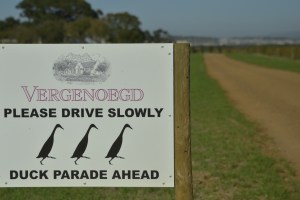
A sign reads “Please drive slowly. Duck parade ahead.”
vergenoegd
A sign at the entrance to Vergenoegd wine estate reads “Please drive slowly. Duck parade ahead”. PHOTO: Mary Lamontagne

On arrival I am greeted with rosé champagne, “pink in colour because it has been darkened with red grapes,” explains Marlize Jacobs, the resident winemaker. Jacobs studied winemaking at Elsenburg College in Stellenbosch.

In 1696, Simon van der Stel, governor of the Dutch Cape Colony, granted the farm to Pieter de Vos, who named it “Vergenoegd” which translates to “satisfaction has been achieved”.

In 1862, the estate was purchased by Johannes Gysbertus Faure whose family owned it for six generations.

One of the oldest farms in Stellenbosch changed hands in 2015 when new life was breathed into it.

file_005
The vineyards at Vergenoegd wine estate, which is on Baden Powell Drive.  PHOTO: Saarah Survé

At Vergenoegd, you can order a picnic lunch to enjoy on the lawn (prices range from R125 to R450) or book a seat at the long harvest table (R250 pp) and share a meal, prepared by Chef Ryan Shell, with unfamiliar faces. In winter, the harvest table is moved inside the wine cellar.

I take my seat at the harvest table under the oak trees, next to two young women from Montreal. The concept of breaking bread with strangers is a fun way to meet new people. We exchange contact details before the end of the meal.

2016-04-10-12-10-07
People enjoying lunch at the harvest table at Vergenoegd wine estate. PHOTO: Mary Lamontagne

Shell, who trained at the Cordon Bleu Cookery School in Johannesburg, welcomes us and explains that we will be eating family-style. This means that all of the dishes are put onto the table so that we can serve ourselves. He also mentions that we should not miss the ducks at 3:30pm.

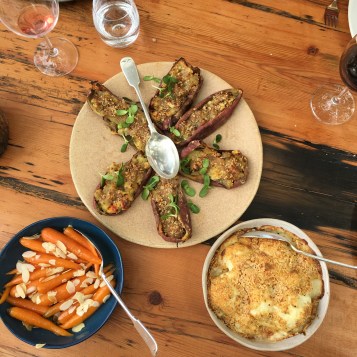
Shell, who previously worked at Haute Cabrière in Franschhoek, uses the produce grown in his own garden at Vergenoegd in his cooking.
2016-02-20-13-52-39
Vegetables from Chef Ryan Shell’s garden served family-style for lunch. PHOTO: Saarah Survé

He personally brings dish after dish to the table, including duck pâté and a whole fish, each served on beautiful ceramics paired with wine from the estate. Each dish is presented with pride and it is evident that the chef treats his products with the utmost respect.

2016-02-20-14-34-17
Dessert prepared by Chef Ryan Shell served family-style. PHOTO: Mary Lamontagne

“Vergenoegd”, I sit back, slip my feet out of my sandals and wiggle my toes through the dried peach pips, a clever and sustainable way to decorate the ground.

After our three-course lunch, we are invited into the Cape-Dutch manor house to choose one of the four blending experiences: coffee, tea, wine or olive oil. We are reminded once again not to be late for the ducks.

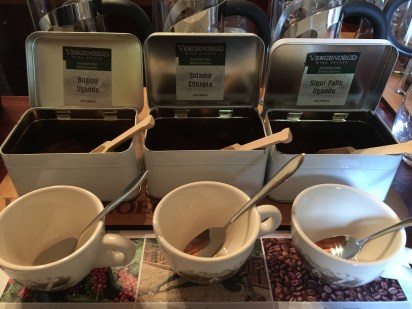
At the coffee blending experience, we are tasked with creating the perfect cuppa with coffees from Uganda and Ethiopia, presented in square silver tins. With small wooden spoons we scoop mounds of the Bugiso, Sippi Falls and Sidamo into French coffee presses and soon the strong aromas of coffee fills the room.
file_001-2
Three types of coffee arranged for the coffee blending experience at Vergenoegd. PHOTO: Saarah Survé

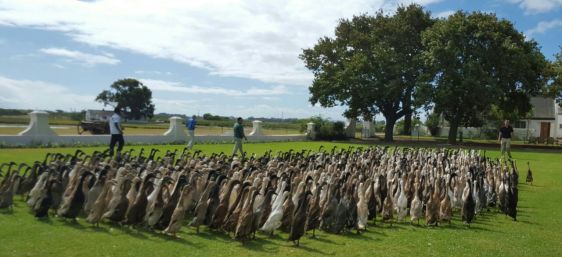
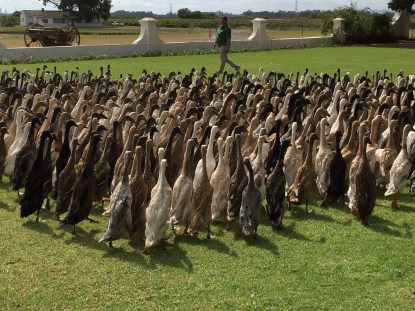
About 30 minutes into our blending experience, we are ushered out of the manor house and onto the lawn. The distant sound of quacking grows louder until we can hardly hear each other. Puzzled searching reveals a flock of about 1 000 Indian Runner Ducks determinedly waddling from the direction of the dam. The ducks, which are domesticated, stand erect and, like penguins, cannot fly.

Herded by a man in the back and a woman in the front, almost as if they are in an invisible enclosure, moving as one unit, the ducks make their way past us, leaving a trail of small feathers in their wake.

One slightly dishevelled duck tries to make a beeline back to the dam, but jumps back into line, after his path is blocked.
file_000-3
The Indian Runner Ducks parade through Vergenoegd wine estate. PHOTO: Saarah Survé

The wine estate uses the ducks to help with natural snail and pest-control in their vineyards. The estate has been refining this practice since 1984.

The ducks work on alternate days and are herded back and forth from the dam or vineyards to their enclosure in the morning and evening.
file_000-4
The Indian Runner Ducks parade through Vergenoegd wine estate. PHOTO: Saarah Survé

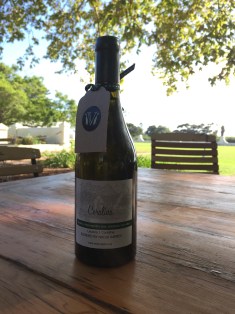
Then back to the coffee blending. If you enjoy the blend of coffee, tea, olive oil or wine that you make, it will be packaged and personalised for you to take home. You can even re-order your blend in the future, because every custom blend is stored in the Vergenoegd library.
file_002
Here is a custom belnd of olive oil which has been packaged and personalised . PHOTO: Saarah Survé

According to their website, every Saturday the wine estate hosts a market from 10am to 4pm. In the summer months they host outdoor movie nights under the stars.

If you still aren’t convinced that Vergenoegd is the place to spend a lazy day, for the series aficionados, the television show Black Sails was partially filmed at Vergenoegd.

2016-02-20-15-30-59
The Cape-Dutch manor house at Vergenoegd wine estate. PHOTO: Mary Lamontagne

Here is a link to Vergenoegd’s website: http://vergenoegd.co.za/

Maties confident about reaching Varsity Cup finals

21 September 2016

Stellenbosch – Stellenbosch University’s netball team have won the last three rounds of the Varsity Cup season and Coach Christine Behan believes they can make it to the finals.

“I definitely believe we will make the semis as we should finish in the top four, but whether we go all the way to finals again depends on who and where we play the semis. That is our goal though and I believe we can do it. We have a great team and if our shooters are accurate, we are hard to beat,” said Behan.

Maties scored five consecutive goals within the first two minutes of Monday’s game against the University of Cape Town (UCT). Behan said it was their goal to lead 5-0 and start strong. Maties beat UCT 69-25.

Captain Juline Rossouw (24) attributes Monday’s success to sticking to the game plan. “It’s something that we have struggled with in the last few games. It was great getting it right in front of our home crowd. It’s very important to make a statement on court from the start. Nobody wants to start on the back foot.”

14364673_1402971049731857_2651218300107648304_n
Juline Rossouw (left), captain of the Maties netball team, in action during Monday’s game against UCT.                        PHOTO: provided by Juline, taken by Stefan Stander photography.

Maties will play the Vaal University of Technology (VUT) on Monday 26 September at 18:00 at Coetzenburg Indoor Centre.

“This will be a very important game for us to get up our scoring average, which might count in our favour going forward in this competition,” said Rossouw, who plays goal defence.

She added that the game against VUT will be a good opportunity to showcase some of the team’s younger players.

Behan said that the team will use the game to practise combinations that they want to use against the University of the Free State.

Maties play Kovsies on Thursday 29 September at Coetzenburg Indoor Centre.

“It will be our most difficult match, because that result will determine where we finish on the log and who we will play in the semi-finals. It’s a very important and a crucial match for us. We are still hoping for a home semi-final too,” said Behan.

North-West University’s Pukke beat Maties 50-37 in 2015’s final. Despite this, Behan has made minimal strategic changes this year.

“Once we know who we will play in the semis we will analyse that team and train according to our specific game plan for that specific match.”

Pityana reflects on legacy of Biko and black consciousness

13 September 2016

Stellenbosch University – Professor Nyameko Barney Pityana (71), professor emeritus of law at the University of South Africa and president of the convocation at the University of Cape Town, said South Africa is missing out on a society of intellectuals and the promotion of a thinking society, without black consciousness.

“Why is it that there is so much interest at an intellectual level in Steve Biko, but very little evidence in society in general and public life of his influence?” asked Pityana, as he addressed students and staff at Stellenbosch University (SU) on Tuesday, the day after the anniversary of Steve Biko’s death.

Pityana was a founding member of the South African Students’ Organisation and an important figure in the Black Consciousness Movement with Biko.

Pityana said that he wished black consciousness was becoming a tool for conversation and for understanding South African society today. “I wish it was a tool for framing much of what we are doing in South Africa today, for framing the new humanity which we are pursuing and what our constitution is actually about, for recognising that there is no future in the unequal society that we are today. There is no future in a society that has large numbers of poor people. There is no humanity in a society that is racist.”

Pityana said that neo-colonialism, neoliberalism, individualism and greed have destroyed the humanity of South Africans.

“The current government of the African National Congress lacks an intellectual frame in which it can move South Africa forward,” said Pityana, who, in an open letter written in 2013, asked President Jacob Zuma to resign.

“Black consciousness could affect leadership and values. It would provide leadership with tools for assessing what the appropriate values that we need in our society are.”

Pityana noted that there is “a growing influence and articulation of black consciousness, a growing readiness on the lips of many, particularly young people and scholars, and a growing number of studies that are being done on Steve around the world.”

Biko’s grandson, Avela Biko (19), who is in his first year of a Bachelor of Arts degree at SU, was also in attendance. He said that, as a young South African, it was overwhelming growing up with the knowledge that Steve Biko was his grandfather. “I never got the chance to meet him. It was always hard to hear things about him, but it’s been a pleasure growing up, getting more information and getting to know him. It’s a privilege to be his grandson, because he did a lot for the country and his influence is still felt today.”

See more of Pityana’s presentation below:

Now is the time for white people to listen and learn

Monday, 15 August 2016

Saarah Survé

Stellenbosch University – Mary Maria Burton (76), former president of the Black Sash and a commissioner on the Truth and Reconciliation Commission (TRC), said that it is time for white people in South Africa to listen to and learn from black people.

Burton made this comment when she addressed honours students from Stellenbosch University’s journalism department.

“I said that it’s time for whites to shut up,” said Burton referring to a recent interview. “I think what I meant is that even today we tend to have opinions and speak them, especially those of us who were opposed to the previous government and were accustomed to fighting for a space. I think it’s time to listen, more than talk. It’s time to learn, more than teach.”

Zenariah Barends, head of investigations for the TRC in the Western Cape, worked closely with Mary Burton during the TRC process. Barends spoke about Burton with great admiration. “She was amazing, a wise woman who I had an incredible amount of respect for. She was never arrogant or boastful. She was very mild-mannered. She always listened. She was someone that you felt you could actually talk to. ”

Barends agreed that those who have benefitted from apartheid need to listen and not be defensive. “They should in fact heed to the words of someone like Mary Burton.”

Burton explained that South Africa’s western bias does not allow for a diversity of opinions and ways of settling disputes that are traditionally available in South Africa. “It does not leave space for learning from one another.”

Although Burton said that the Black Consciousness Movement isolated the Black Sash, her sentiments are not in opposition to what Steve Biko, the founder of the movement, expressed in his book, I Write What I Like.

Biko was against the “superior-inferior, white-black” divide that made the white person a teacher and the black person a student. Biko was also “against the fact that a settler minority should impose an entire system of values on an indigenous people”.

Allister Sparks, in his book The Mind of South Africa, wrote that Biko believed in the primary necessity of “blacks to emancipate themselves” so that “they could deal with whites on equal terms in their own minds: otherwise the inequality would continue, with whites calling the tune and the blacks following submissively”.

Burton alluded to this when she asked: “Can we sufficiently sit back and not say ‘yes, but…’ when people tell us things?” She said that South Africans have a fantastic opportunity ahead of them if they learn to listen.

“I see signs of great courage among young people now, whose parents were exhausted and also felt that they could not betray the cause by criticising their leaders,” said Burton. “I think that has changed and I hope that we have not left it too late and that this next generation is going to bring about the change.”

De Villiers reflects on challenging year at SU

Monday, 1 August 2016

Saarah Survé

Stellenbosch University – In just one year at Stellenbosch University (SU), the vice-chancellor, Professor Wim de Villiers, has experienced five of the six main areas of student protests.

These  include tuition, rape culture, black lives matter, decolonisation of the university and outsourcing and insourcing.

“I didn’t know what I was signing up for when I became vice-chancellor,” said De Villiers, as he addressed honours students from SU’s journalism department. “There is no textbook on how to handle student protests.”

De Villiers, who started his new position on 1 April 2015, said that his time at SU has been complex and challenging, but very rewarding. He joked with the students that perhaps he should not have started on April fool’s day.

De Villiers, who is a doctor, said that his background in medicine helps him to deal with the complex issues that he faces at SU.

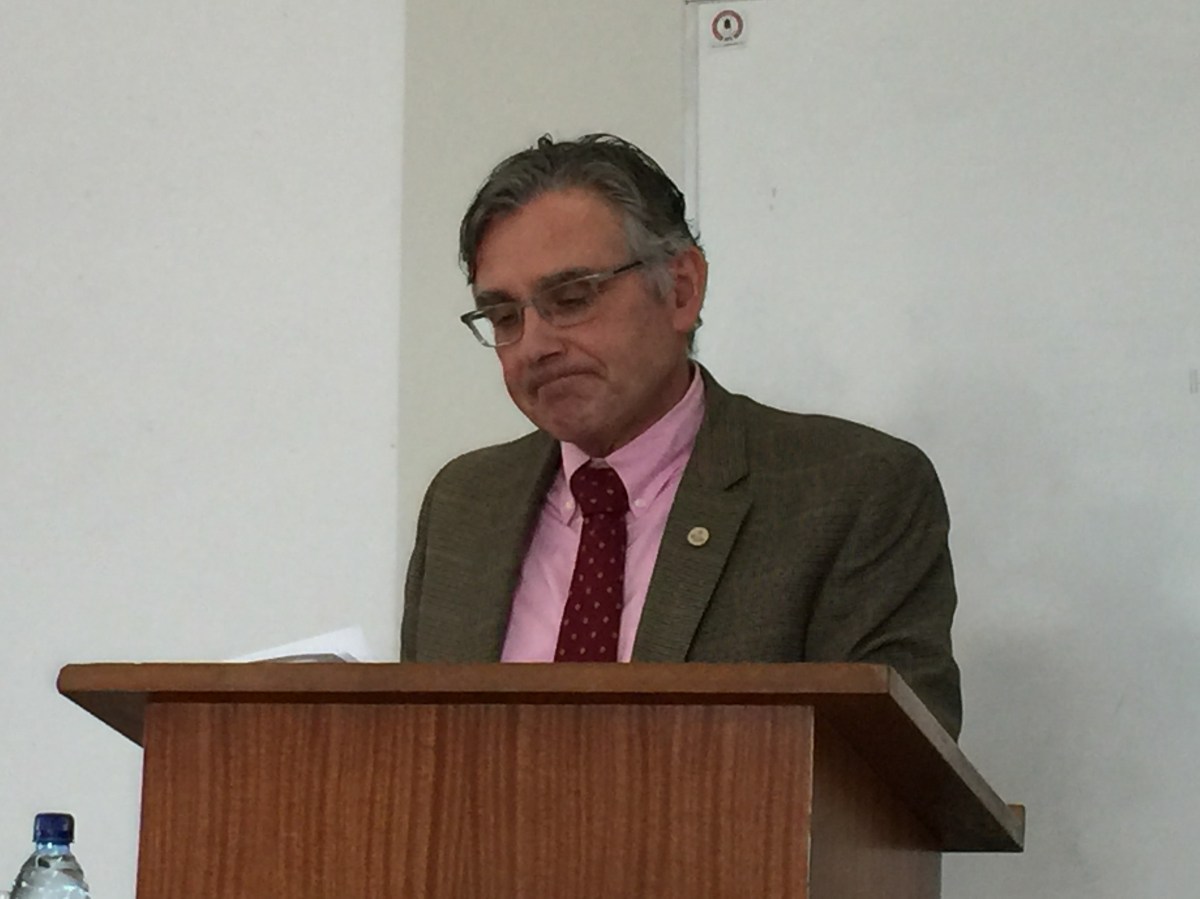
prof-wim-de-villiers-addresses-su-students-1
Prof Wim de Villiers addresses SU journalism students PHOTO: Saarah Survé

At one stage last year, De Villiers had to stop using social media, because of a hashtag that was making the rounds (#WimdeVilliersmustdie). He said that such a hashtag does not promote useful discussions, but that he is willing to engage with students.

When asked about transformation at SU, he responded by saying that “transformation is a complex issue”. He also said that transformation is a word which has lost all meaning. De Villiers does believe, however, that the university is being transformed.

De Villiers also addressed the issue of fee increases. Although De Villiers noted that students have been fairly quiet at the university lately, he is aware that an increase in tuition, which is inevitable, could spark more protests. “We cannot afford free education for all. As a country, we are not economically developed enough.”

De Villiers said that a sustainable university needs fee increases, but alluded to the poor being exploited in the event of no increase. “All that a 0% fee increase means is that the rich get a massive bargain and the poor suffer… It’s a perverse system.”

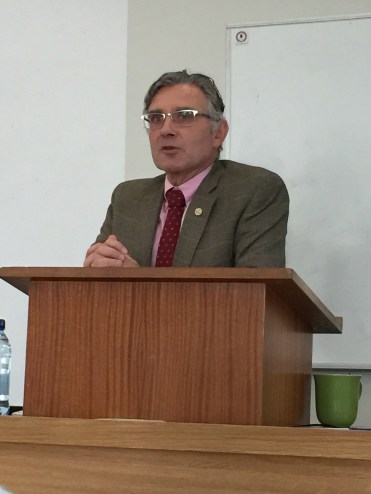
prof-wim-de-villiers-addresses-su-students-2
Prof Wim de Villiers addresses SU journalism students PHOTO: Saarah Survé

De Villiers’ advice to his successor would be to communicate. He said that whenever he thought he had communicated enough, he realised that he had not.

From Pollsmoor to a parking lot: the story of Attie van der Merwe

“If you forget my name, just think of Tolla van der Merwe, but I’m just Arthur van der Merwe… you can call me Attie.”

3 August 2016

Janie Du Plessis and Saarah Survé

Another lost soul forgotten by society and left to wander the streets of Stellenbosch. To passers-by he is invisible. Nobody stops to talk to him.

Arthur Nico van der Merwe, 45, sits with his legs spread out in the middle of a parking lot in Andringa Street in Stellenbosch. He is staring at his hands. His left ankle looks twisted as it lies at an odd angle, his foot peeking out of his black, broken boot. The rubber soles have detached themselves from the boot and his black and white laces are untied.

He sighs audibly. “I’m not having a good day. I’m so hungry.”

He has permanent frown lines which have been etched onto his forehead. But his eyes are sparkling and his kind face is covered by a black beard, peppered with grey hairs. His two front teeth are missing.

IMG_5107
Arthur van der Merwe waits for his brother in a parking lot in Andringa Street.      Photo: Saarah Survé

Arthur was released from Pollsmoor Maximum Security Prison in Cape Town two days ago, after one year as an inmate.

“God put me in jail. I had to go to prison, because I broke the law. I did the things that I must do.” He pauses, but does not explain further.

“I’m sitting here waiting for Edward, my brother. He is supposed to pick me up today. He didn’t come yesterday, but I know he will come today.”

Arthur stares at his hands again. His fingernails are long and sharp. Black dirt has built up underneath them. They look like they could be used as a weapon. His hands are scarred and caked with brown dirt. He holds tightly onto the chocolate muffin in his hand.

“As long as I am out of prison, I’m happy. Pollsmoor is a horrible place. It is so boring there, there is nothing to do,” he says.

Arthur used to work at a tyre-swop company in Cloetesville before going to Pollsmoor. Now he works at Stellenbosch Provincial Hospital where he washes the hospital’s cars.

Before taking a bite of his muffin, he says: “I have to work at the hospital, because I have to make money. When I have money, I can buy food.”

Little crumbs of muffin get stuck in his beard and more fall to the ground. When he takes the last bite, he wipes his fingers onto his faded blue jeans already dusted with dirt.

“Most of the time I buy food, but sometimes I buy wine. Wine makes me warm when I sleep and it makes my chest feel better,” he says, as he pretends to drink from an imaginary bottle.

His dark green and red jersey appears to be too big. Threads hang off the jersey and there’s a hole in the fabric in the middle of his chest.

“In the winter it’s not nice here. When it rains I sit in this parking lot. I sit in the rain, but I pretend like I don’t get wet and cold, because there is nothing I can do about it.”

He rolls the letter “r” when he speaks and speaks comfortably in both English and Afrikaans. He switches between the two with ease.

IMG_5108
Arthur van der Merwe waits for his brother in a parking lot in Andringa Street.      Photo: Saarah Survé

“You know, the devil got in me… He told me to take my wife away… I buried her myself.”

Arthur suddenly cringes at this thought and twists his foot all the way out of his shoe.

“I did what I had to do; I took her away because she made love to my brother. I told my brother as well, I told Johan that I will kill him too.”

It seems like the betrayal by his wife, Synobia, still bothers him today. “I married her for life. My brother sleeps around with lots of women, he could have left mine alone,” he says, looking away.

“Anyway, I have a new woman now.” The sudden change in subject indicates that he is finished talking about Synobia.

For the past two nights, Arthur has slept in the doorways of local shops.

“The police won’t chase us away when we sleep there, they want to help us,” he says.

Even though the police do not bother Arthur, it’s the way other people treat him that troubles him most.

“Some people look at me in a funny way, but then they just walk past. They don’t ask questions and they don’t give answers. But if they want to be like that, it’s better that they stay away. Then the devil also stays away.”

Arthur thinks to himself and plays with the muffin paper in his hand.

“If you forget my name, just think of Tolla van der Merwe, but I’m just Arthur van der Merwe… you can call me Attie.”

Majuba prim sees change in residence’s attitude

6 April 2016

Saarah Survé, Stellenbosch Department of Journalism

Stellenbosch University – Irene primaria, Lize-Mari Doubell, and Majuba primarius, Hein Stegmann, have collaborated to change male students’ perceptions of females, after degrading posters were placed around Majuba residence last week.

A first-year student on Majuba’s social committee put up degrading posters advertising a social event with the women’s residence, Irene. Doubell, head of the women empowerment task team, was notified and immediately cancelled the social.

“We had to think carefully about our next move,” said Doubell. “Reporting a residence to the university’s Equality Unit is the normal route that is taken when there is a case of discrimination, gender inequality or objectification, but we wanted to engage with Majuba.”

Doubell explained that Irene did not want to take disciplinary action, because behaviours would not have changed through disciplinary action alone. “All that Majuba would have to do is tick the boxes; apologise, appear before the committees and panels and be banned from a social event.”

“We decided to work with Majuba to combat rape culture and the objectification of women. For first-year students to think that it is okay to make degrading posters about women, speaks to a greater culture of what residences and men allow. Residences are normalising the objectification of women,” said Doubell.

Doubell said she told Majuba’s house committee members that Irene wanted to see tangible change take place in Majuba’s culture. “It’s about more than one poster; it’s about changing the culture of men’s residences on campus, and creating a positive impact.”

Stegmann said that Irene’s decision not to report them has been a massive blessing. “When you are reported, it feels like all you are trying to do is defend yourself. You start in a defensive mind-set. But as soon as someone is willing to work with you, you know that their intentions are good.”

Stegmann said it has been a whirlwind week for Majuba with many conversations, group discussions, education and progression.

“In my four years in Majuba, we have never had critical discussions about women empowerment and gender equality.

“First the guys said that maybe Irene was too sensitive, but then they started asking questions; how do we feel, is it offensive, and what is the problem,” said Stegmann.

“I saw them click. They realised they have to change. This situation has been a call for not only Majuba men to step up, but all men,” said Stegmann. “It is a dark cloud with a silver lining. It’s our image that is being made an example of, but in the long run, it’s for the good.”

The two residences had an optional rape culture talk on Tuesday night, with about 90 Majuba men out of 150 present. Doubell said it was evident that rape culture was a new concept for a lot of them.

“There was a lack of understanding, and it is clear that there is a gap in men’s education.”

However, Doubell said that the men were open to the idea. “They didn’t take a defensive stance. They are tackling the issue head-on, and I think that’s what will make a huge difference.”

Doubell said that there is still a lot of work to be done on both sides. They have asked Majuba to consider being the first men’s residence on campus to have a women empowerment portfolio on their house committee.

Next on their agenda is a meeting with the heads of all 44 residences and private student organisations.

SU students go wild for natural medicine

30 March 2016

Saarah Survé, Stellenbosch Department of Journalism

Stellenbosch – KeenMind, a natural alternative to medications like Concerta and Ritalin, is flying off the shelves at the Eikestad Mall pharmacy in Stellenbosch, according to Michael du Preez, who supervises the pharmacy’s vitamin laboratory.

KeenMind claims to improve mental performance.

“It is our biggest seller at the moment as more students move towards a more natural option. We recommend it, because students don’t need a script to buy it and it doesn’t cause a crash, like Concerta and Ritalin, which you do need a script for,” said Du Preez, a biochemist.

Du Preez advised students to skip a weekend of partying and invest in their health instead, which will in turn benefit their education, as they will be able to concentrate better.

“In relative terms, these supplements are not expensive; R205 to R250 for a month’s supply is a tiny price to pay for delayed gratification.”

Du Preez said that KeenMind can work as quickly as three to four days. He added that no serious side effects have been recorded.

Du Preez has first-hand experience with Ritalin, as he was prescribed the drug at age 13. He says that it changed his character. “You become subdued. It’s like a tranquiliser.”

Similarly, Jacques Booyens, a Stellenbosch University (SU) graduate, began using Ritalin at the age of eight. He stopped this year and is studying for the first time without any medication.

Booyens admitted to trying a few natural products for focus, but felt like a lot of them were “just snake oil.”

De-Ann Snyders, a Stellenbosch student in industrial engineering, was also diagnosed with ADD and has been on Concerta for two years.

Snyders said that she tried Bio-Strath, a daily herbal nutritional supplement, but that taking the medication became too much administration for someone with ADD. “It took four days to get into my system and I had to take six pills a day. As someone with ADD, I don’t understand why people want this drug so much.”

“It’s also expensive (about R460 for 300 tablets) and made me very agitated. I felt like a zombie,” said Snyders. “If you don’t need it, stay away. It will help anyone concentrate better, but once you realize that it helps, it can become addictive,” she warned.

Du Preez said that it is important for students to know that there are natural options available, like KeenMind, which doesn’t have negative side effects. He asked students to consider these before they take other medications, such as Ritalin and Concerta.

Nwadeyi: South Africans must reclaim their humanity

28 February 2016

Saarah Survé, Stellenbosch Department of Journalism

Stellenbosch University – Lovelyn Nwadeyi, a Stellenbosch student from 2010 to 2012, has called on South Africans to reclaim their collective humanity, histories and languages so that their children will know the truth about themselves.

Nwadeyi addressed former and current students, as well as fulltime academic staff members, at the annual meeting of the Stellenbosch University Convocation on Thursday.

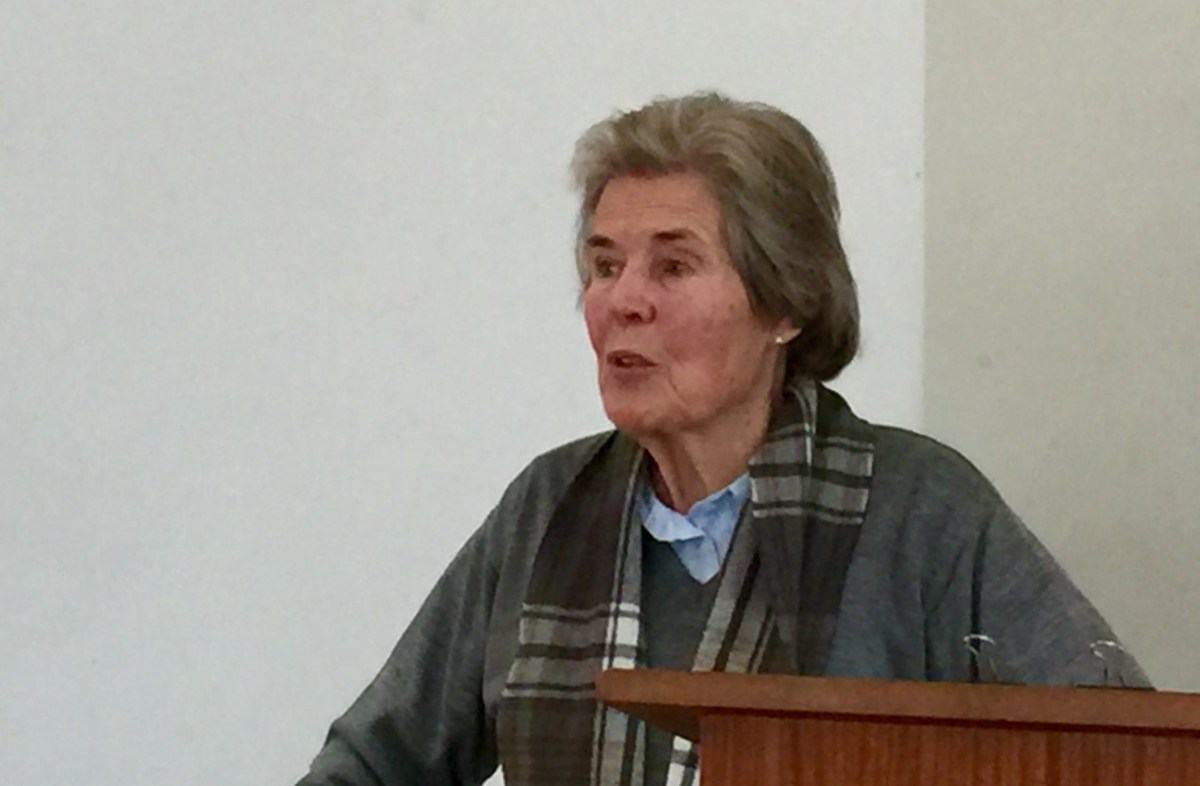
Nwadeyi is the youngest black woman to address the SU Convocation. Her speech reflected on the differences of the Stellenbosch she attended and the one that exists today.

Fighting back emotion, she explained that it is difficult for her to talk about courage and compassion. “The rainbow nation ideal promised… in 1994 is becoming an ever-distant one,” she said. Nwadeyi added that “perhaps we are realising that there was no rainbow to start with.”

“South Africans are now faced with the task of looking into the mirror, and asking themselves what is happening around us and why does it feel this way?” said Nwadeyi, who is cautiously questioning what is new about Stellenbosch and South Africa.

“Something is brewing in South Africa… I know it is irreversible and will continue to brew and boil over whether we give it the permission to do so or not,” she said.

“Stellenbosch is not exempt from the winds of change that are blowing through this country,” said Nwadeyi. She also stated that Stellenbosch is responsible for many of the inequalities that South Africa faces today.

Nwadeyi said that the difference between South Africa and Germany is that the Germans are genuinely sorry about the past and have written off that part of their history as unequivocally bad, whereas South Africans are nostalgic for the good old days.

“We must dismantle this inhumanity that we are all products of, by reclaiming our collective humanity…and our languages,” said Nwadeyi.

While addressing the convocation, Nwadeyi slipped effortlessly between English and Afrikaans, illustrating her point that there are many faces to Afrikaans as a language and a culture.

She ended her speech with the hope that one day it would not be necessary for her to talk to her children about racism and sexism. “That is really my dream for South Africa, and Africa as a whole, but for us to get to that point, we need to know about the roles we need to play,” she explained.

“None of us get to claim an easy victory, because there is no victory in our collective pain, there is only closure… which South Africa desperately needs,” said Nwadeyi.

At the convocation, five new members were elected onto Stellenbosch University’s executive committee. According to City Press, Nwadeyi was a candidate for the position of vice-chair on the committee, but lost by 15 votes. None of the 5 black candidates were elected.

James de Villiers, Head of Communication of Stellenbosch University’s Student Representative Council, said that Stellenbosch University’s Convocation was disappointed in the result of the meeting.

“They had a chance to vote for a truly transformed statutory body that represents Stellenbosch’s changing demographics and needs, but chose not to.

“The Convocation chose to remain within the boundaries of what is comfortable and, in real terms, regressed in its representation of diversity and much needed transformation,” said De Villiers.

De Villiers said it is concerning that Breyten Breytenbach, South African poet and writer and the second speaker at the convocation, “represents a bygone era, where the university represented one culture, one race and one language.”

Nwadeyi has a Master’s Degree in Peace Studies and Conflict Resolution from Uppsala University in Sweden.

Antia challenges basic education stance

18 February 2016

Saarah Survé, Stellenbosch Department of Journalism

Stellenbosch University – Professor Bassey Antia from the University of the Western Cape (UWC)  has set out to challenge the Department of Basic Education’s (DoBE) statement that it is not viable to use African languages for matric exams.

Antia said that when learners are not tested in their home languages, it affects their matric results. Speakers of African languages, in particular, score the lowest.

“The exam paper itself should not be a challenge, the content of the paper should,” said Antia.

In his study of matric exams, the professor found that students would flip their exam papers over to read the Afrikaans side, when they did not understand the term in English, and vice-versa.

“Terms in one language can be more descriptive than in another language,” said Antia.

“There is knowledge embedded in terms,” said Antia. For example, there are two words for canine in Afrikaans; oogtand and slagtand. The former shows the tooth has a relation to the eye, and the latter that the tooth is used for tearing. So, knowledge of Afrikaans will enable better understanding of the word canine.

“Knowing several languages can afford different entry points to understanding,” said Antia.

For example, the word computer, when translated into English from other languages, means “machine with a brain” or “ability to calculate.”

“Processing information in testing can be influenced by languages in which the test is presented and/or languages known by the examinees,” said Antia. “When a bilingual student reads an exam paper, essentially what happens is that the individual’s two languages are acting or contesting at the same time. You cannot just switch off one language. This is called parallel activation,” Antia explained.

“We need to accommodate students to content and process,” said Antia. “This involves taking away language as a barrier. One part of that would be translating the text in an exam paper into a student’s home language. Another part would be to change the time of a paper, if students are more likely to perform better in the morning,” he said.

Antia suggested providing learning materials in the student’s home language, even if they are being lectured in another language.

Boipelo Mokgothu, a University of Johannesburg journalism graduate and native Tswana-speaker, and Velani Mboweni, a University of Cape Town Politics, Philosophy and Economics (PPE) graduate and native Zulu-speaker commented on the lack of African languages in the educational context.

Mokgothu said that she had never come across a school that used an African language as a teaching medium and that she had only encountered English and Afrikaans schools.

“I have never heard of a school that teaches maths, life sciences and natural sciences in Tswana. I think that would be very difficult,” said Mokgothu.

“Even schools in Soweto, where I come from, will have Tswana as a subject, but all of the other subjects would be in English,” said Mokgothu.

“Given the choice, I would not have wanted to study in Tswana. It would have been too difficult and meant that I would have had to go to a non-English school, which doesn’t make sense in the world we live in,” said Mokgothu.

“To be honest, I wouldn’t have taken Tswana as an additional language, even if I could, because I was comfortable in Afrikaans,” she said.

Mboweni, who took isiZulu as his first additional language, said that he would have liked to study some subjects “concurrently with English”, because it would have enabled him to learn in his own language, but still “remain internationally competitive.”

Mboweni said that he was forced to choose English, because he wanted to study PPE at UCT. He would have been excluded from the international literature if he had not gone to an English high school.

Antia is from Nigeria and lectures at UWC’s Department of Linguistics. He speaks six languages and can order a cup of coffee in eight. Antia hopes to approach the DoBE with his findings in the middle of this year.