Ducks earn their keep at Vergenoegd

27 September 2016

Look no further than Vergenoegd wine estate for a lazy day of basking in the sun and tantalizing your palate, but don’t miss the duck parade. 

As you take the Baden Powell Drive exit off the N2, it is easy to miss the entrance gates adorned with white plaster ducks. From there, an equally unassuming gravel road will lead you to Vergenoegd wine estate, the gateway to the Stellenbosch Wine Route.

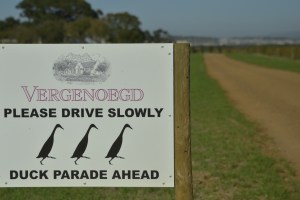
A sign reads “Please drive slowly. Duck parade ahead.”
vergenoegd
A sign at the entrance to Vergenoegd wine estate reads “Please drive slowly. Duck parade ahead”. PHOTO: Mary Lamontagne

On arrival I am greeted with rosé champagne, “pink in colour because it has been darkened with red grapes,” explains Marlize Jacobs, the resident winemaker. Jacobs studied winemaking at Elsenburg College in Stellenbosch.

In 1696, Simon van der Stel, governor of the Dutch Cape Colony, granted the farm to Pieter de Vos, who named it “Vergenoegd” which translates to “satisfaction has been achieved”.

In 1862, the estate was purchased by Johannes Gysbertus Faure whose family owned it for six generations.

One of the oldest farms in Stellenbosch changed hands in 2015 when new life was breathed into it.

file_005
The vineyards at Vergenoegd wine estate, which is on Baden Powell Drive.  PHOTO: Saarah Survé

At Vergenoegd, you can order a picnic lunch to enjoy on the lawn (prices range from R125 to R450) or book a seat at the long harvest table (R250 pp) and share a meal, prepared by Chef Ryan Shell, with unfamiliar faces. In winter, the harvest table is moved inside the wine cellar.

I take my seat at the harvest table under the oak trees, next to two young women from Montreal. The concept of breaking bread with strangers is a fun way to meet new people. We exchange contact details before the end of the meal.

2016-04-10-12-10-07
People enjoying lunch at the harvest table at Vergenoegd wine estate. PHOTO: Mary Lamontagne

Shell, who trained at the Cordon Bleu Cookery School in Johannesburg, welcomes us and explains that we will be eating family-style. This means that all of the dishes are put onto the table so that we can serve ourselves. He also mentions that we should not miss the ducks at 3:30pm.

Shell, who previously worked at Haute Cabrière in Franschhoek, uses the produce grown in his own garden at Vergenoegd in his cooking.
2016-02-20-13-52-39
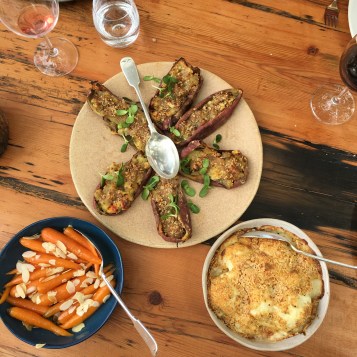
Vegetables from Chef Ryan Shell’s garden served family-style for lunch. PHOTO: Saarah Survé

He personally brings dish after dish to the table, including duck pâté and a whole fish, each served on beautiful ceramics paired with wine from the estate. Each dish is presented with pride and it is evident that the chef treats his products with the utmost respect.

2016-02-20-14-34-17
Dessert prepared by Chef Ryan Shell served family-style. PHOTO: Mary Lamontagne

“Vergenoegd”, I sit back, slip my feet out of my sandals and wiggle my toes through the dried peach pips, a clever and sustainable way to decorate the ground.

After our three-course lunch, we are invited into the Cape-Dutch manor house to choose one of the four blending experiences: coffee, tea, wine or olive oil. We are reminded once again not to be late for the ducks.

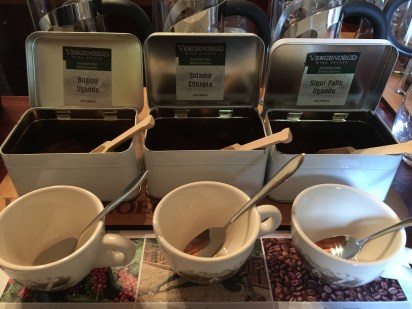
At the coffee blending experience, we are tasked with creating the perfect cuppa with coffees from Uganda and Ethiopia, presented in square silver tins. With small wooden spoons we scoop mounds of the Bugiso, Sippi Falls and Sidamo into French coffee presses and soon the strong aromas of coffee fills the room.
file_001-2
Three types of coffee arranged for the coffee blending experience at Vergenoegd. PHOTO: Saarah Survé

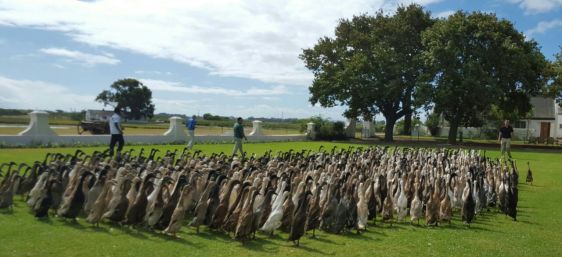
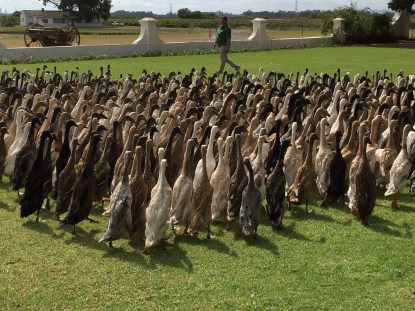
About 30 minutes into our blending experience, we are ushered out of the manor house and onto the lawn. The distant sound of quacking grows louder until we can hardly hear each other. Puzzled searching reveals a flock of about 1 000 Indian Runner Ducks determinedly waddling from the direction of the dam. The ducks, which are domesticated, stand erect and, like penguins, cannot fly.

Herded by a man in the back and a woman in the front, almost as if they are in an invisible enclosure, moving as one unit, the ducks make their way past us, leaving a trail of small feathers in their wake.

One slightly dishevelled duck tries to make a beeline back to the dam, but jumps back into line, after his path is blocked.
file_000-3
The Indian Runner Ducks parade through Vergenoegd wine estate. PHOTO: Saarah Survé

The wine estate uses the ducks to help with natural snail and pest-control in their vineyards. The estate has been refining this practice since 1984.

The ducks work on alternate days and are herded back and forth from the dam or vineyards to their enclosure in the morning and evening.
file_000-4
The Indian Runner Ducks parade through Vergenoegd wine estate. PHOTO: Saarah Survé

Then back to the coffee blending. If you enjoy the blend of coffee, tea, olive oil or wine that you make, it will be packaged and personalised for you to take home. You can even re-order your blend in the future, because every custom blend is stored in the Vergenoegd library.
file_002
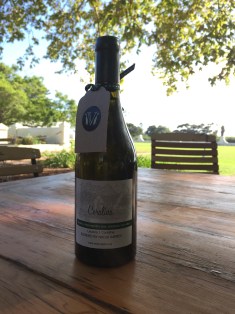
Here is a custom belnd of olive oil which has been packaged and personalised . PHOTO: Saarah Survé

According to their website, every Saturday the wine estate hosts a market from 10am to 4pm. In the summer months they host outdoor movie nights under the stars.

If you still aren’t convinced that Vergenoegd is the place to spend a lazy day, for the series aficionados, the television show Black Sails was partially filmed at Vergenoegd.

2016-02-20-15-30-59
The Cape-Dutch manor house at Vergenoegd wine estate. PHOTO: Mary Lamontagne

Here is a link to Vergenoegd’s website: http://vergenoegd.co.za/

Maties confident about reaching Varsity Cup finals

21 September 2016

Stellenbosch – Stellenbosch University’s netball team have won the last three rounds of the Varsity Cup season and Coach Christine Behan believes they can make it to the finals.

“I definitely believe we will make the semis as we should finish in the top four, but whether we go all the way to finals again depends on who and where we play the semis. That is our goal though and I believe we can do it. We have a great team and if our shooters are accurate, we are hard to beat,” said Behan.

Maties scored five consecutive goals within the first two minutes of Monday’s game against the University of Cape Town (UCT). Behan said it was their goal to lead 5-0 and start strong. Maties beat UCT 69-25.

Captain Juline Rossouw (24) attributes Monday’s success to sticking to the game plan. “It’s something that we have struggled with in the last few games. It was great getting it right in front of our home crowd. It’s very important to make a statement on court from the start. Nobody wants to start on the back foot.”

14364673_1402971049731857_2651218300107648304_n
Juline Rossouw (left), captain of the Maties netball team, in action during Monday’s game against UCT.                        PHOTO: provided by Juline, taken by Stefan Stander photography.

Maties will play the Vaal University of Technology (VUT) on Monday 26 September at 18:00 at Coetzenburg Indoor Centre.

“This will be a very important game for us to get up our scoring average, which might count in our favour going forward in this competition,” said Rossouw, who plays goal defence.

She added that the game against VUT will be a good opportunity to showcase some of the team’s younger players.

Behan said that the team will use the game to practise combinations that they want to use against the University of the Free State.

Maties play Kovsies on Thursday 29 September at Coetzenburg Indoor Centre.

“It will be our most difficult match, because that result will determine where we finish on the log and who we will play in the semi-finals. It’s a very important and a crucial match for us. We are still hoping for a home semi-final too,” said Behan.

North-West University’s Pukke beat Maties 50-37 in 2015’s final. Despite this, Behan has made minimal strategic changes this year.

“Once we know who we will play in the semis we will analyse that team and train according to our specific game plan for that specific match.”

De Villiers reflects on challenging year at SU

Monday, 1 August 2016

Saarah Survé

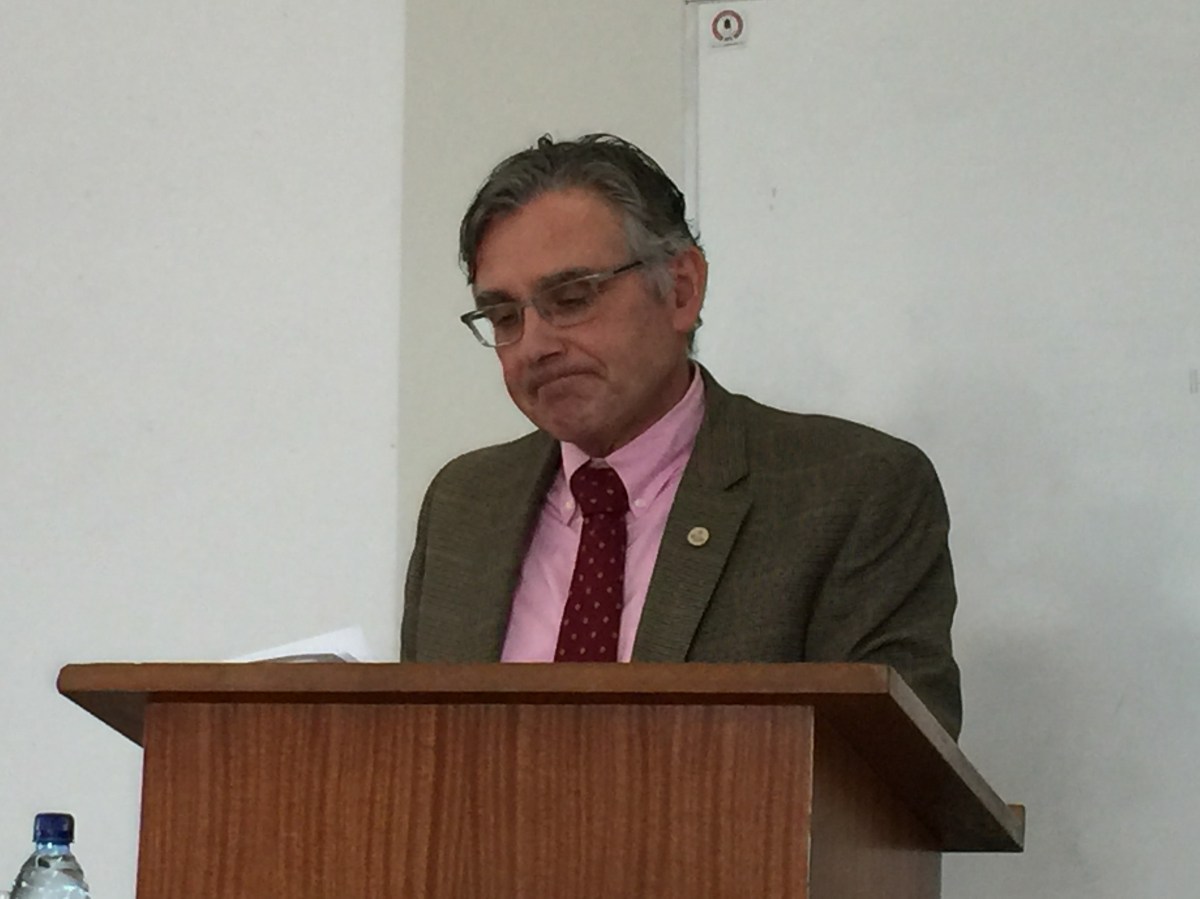
Stellenbosch University – In just one year at Stellenbosch University (SU), the vice-chancellor, Professor Wim de Villiers, has experienced five of the six main areas of student protests.

These  include tuition, rape culture, black lives matter, decolonisation of the university and outsourcing and insourcing.

“I didn’t know what I was signing up for when I became vice-chancellor,” said De Villiers, as he addressed honours students from SU’s journalism department. “There is no textbook on how to handle student protests.”

De Villiers, who started his new position on 1 April 2015, said that his time at SU has been complex and challenging, but very rewarding. He joked with the students that perhaps he should not have started on April fool’s day.

De Villiers, who is a doctor, said that his background in medicine helps him to deal with the complex issues that he faces at SU.

prof-wim-de-villiers-addresses-su-students-1
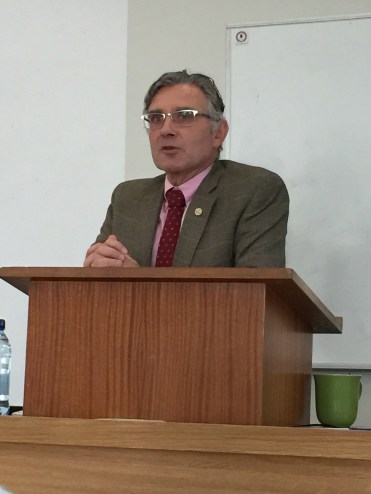
Prof Wim de Villiers addresses SU journalism students PHOTO: Saarah Survé

At one stage last year, De Villiers had to stop using social media, because of a hashtag that was making the rounds (#WimdeVilliersmustdie). He said that such a hashtag does not promote useful discussions, but that he is willing to engage with students.

When asked about transformation at SU, he responded by saying that “transformation is a complex issue”. He also said that transformation is a word which has lost all meaning. De Villiers does believe, however, that the university is being transformed.

De Villiers also addressed the issue of fee increases. Although De Villiers noted that students have been fairly quiet at the university lately, he is aware that an increase in tuition, which is inevitable, could spark more protests. “We cannot afford free education for all. As a country, we are not economically developed enough.”

De Villiers said that a sustainable university needs fee increases, but alluded to the poor being exploited in the event of no increase. “All that a 0% fee increase means is that the rich get a massive bargain and the poor suffer… It’s a perverse system.”

prof-wim-de-villiers-addresses-su-students-2
Prof Wim de Villiers addresses SU journalism students PHOTO: Saarah Survé

De Villiers’ advice to his successor would be to communicate. He said that whenever he thought he had communicated enough, he realised that he had not.

From Pollsmoor to a parking lot: the story of Attie van der Merwe

“If you forget my name, just think of Tolla van der Merwe, but I’m just Arthur van der Merwe… you can call me Attie.”

3 August 2016

Janie Du Plessis and Saarah Survé

Another lost soul forgotten by society and left to wander the streets of Stellenbosch. To passers-by he is invisible. Nobody stops to talk to him.

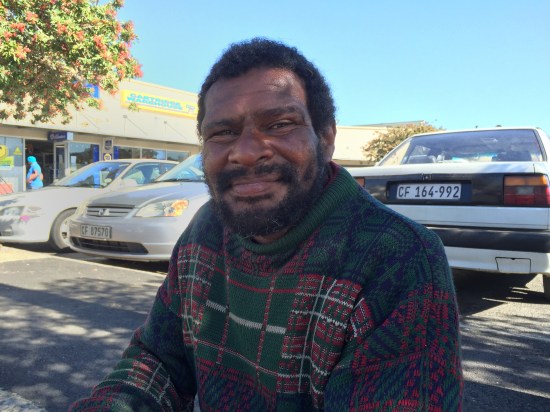
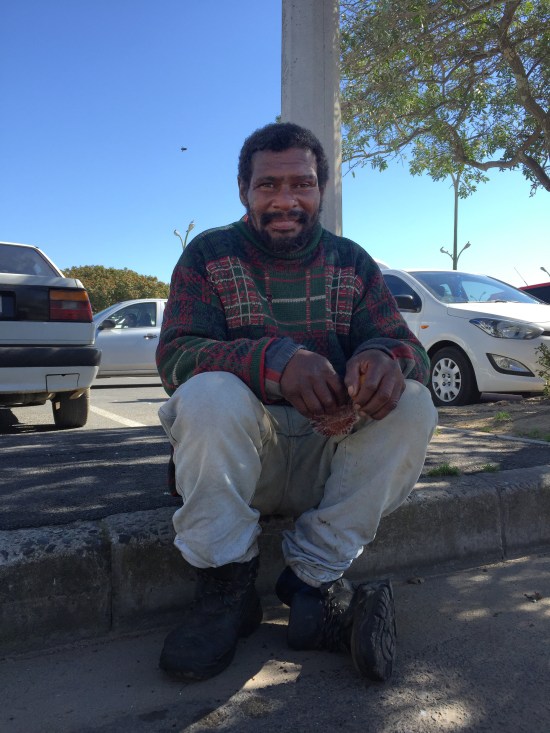
Arthur Nico van der Merwe, 45, sits with his legs spread out in the middle of a parking lot in Andringa Street in Stellenbosch. He is staring at his hands. His left ankle looks twisted as it lies at an odd angle, his foot peeking out of his black, broken boot. The rubber soles have detached themselves from the boot and his black and white laces are untied.

He sighs audibly. “I’m not having a good day. I’m so hungry.”

He has permanent frown lines which have been etched onto his forehead. But his eyes are sparkling and his kind face is covered by a black beard, peppered with grey hairs. His two front teeth are missing.

IMG_5107
Arthur van der Merwe waits for his brother in a parking lot in Andringa Street.      Photo: Saarah Survé

Arthur was released from Pollsmoor Maximum Security Prison in Cape Town two days ago, after one year as an inmate.

“God put me in jail. I had to go to prison, because I broke the law. I did the things that I must do.” He pauses, but does not explain further.

“I’m sitting here waiting for Edward, my brother. He is supposed to pick me up today. He didn’t come yesterday, but I know he will come today.”

Arthur stares at his hands again. His fingernails are long and sharp. Black dirt has built up underneath them. They look like they could be used as a weapon. His hands are scarred and caked with brown dirt. He holds tightly onto the chocolate muffin in his hand.

“As long as I am out of prison, I’m happy. Pollsmoor is a horrible place. It is so boring there, there is nothing to do,” he says.

Arthur used to work at a tyre-swop company in Cloetesville before going to Pollsmoor. Now he works at Stellenbosch Provincial Hospital where he washes the hospital’s cars.

Before taking a bite of his muffin, he says: “I have to work at the hospital, because I have to make money. When I have money, I can buy food.”

Little crumbs of muffin get stuck in his beard and more fall to the ground. When he takes the last bite, he wipes his fingers onto his faded blue jeans already dusted with dirt.

“Most of the time I buy food, but sometimes I buy wine. Wine makes me warm when I sleep and it makes my chest feel better,” he says, as he pretends to drink from an imaginary bottle.

His dark green and red jersey appears to be too big. Threads hang off the jersey and there’s a hole in the fabric in the middle of his chest.

“In the winter it’s not nice here. When it rains I sit in this parking lot. I sit in the rain, but I pretend like I don’t get wet and cold, because there is nothing I can do about it.”

He rolls the letter “r” when he speaks and speaks comfortably in both English and Afrikaans. He switches between the two with ease.

IMG_5108
Arthur van der Merwe waits for his brother in a parking lot in Andringa Street.      Photo: Saarah Survé

“You know, the devil got in me… He told me to take my wife away… I buried her myself.”

Arthur suddenly cringes at this thought and twists his foot all the way out of his shoe.

“I did what I had to do; I took her away because she made love to my brother. I told my brother as well, I told Johan that I will kill him too.”

It seems like the betrayal by his wife, Synobia, still bothers him today. “I married her for life. My brother sleeps around with lots of women, he could have left mine alone,” he says, looking away.

“Anyway, I have a new woman now.” The sudden change in subject indicates that he is finished talking about Synobia.

For the past two nights, Arthur has slept in the doorways of local shops.

“The police won’t chase us away when we sleep there, they want to help us,” he says.

Even though the police do not bother Arthur, it’s the way other people treat him that troubles him most.

“Some people look at me in a funny way, but then they just walk past. They don’t ask questions and they don’t give answers. But if they want to be like that, it’s better that they stay away. Then the devil also stays away.”

Arthur thinks to himself and plays with the muffin paper in his hand.

“If you forget my name, just think of Tolla van der Merwe, but I’m just Arthur van der Merwe… you can call me Attie.”

Does appetite loss help your body to cope?

Why do people often lose their appetites when they are ill?

13 April 2016

Saarah Survé, Stellenbosch Department of Journalism

Stellenbosch – Winter is around the corner and with the seasons changing, more people tend to get sick. But why do people often lose their appetites when they are ill?

Dr Ferial Abdurahman, an obstetrician and gynaecologist at Wynberg Military Hospital, said that the reasons for appetite loss vary, depending on what kind of illness a person has.

“When you are sick your brain releases chemicals called cytokines and these decrease your appetite. Your body receives the message to conserve energy. Sometimes hormones can also play a role,” said Abdurahman.

“Most of the time when you are ill, your body wants to conserve energy to fight the infection, rather than use that energy to digest food. Your body fights the infection with an army of white blood cells (or fighting cells) that multiply and are sent to each organ and into your blood,” Abdurahman explained.

Dr Ramona Stewart, a retired general practitioner, agreed. “Losing your appetite when you are ill gives your body more time and energy to fight off the virus.”

Abdurahman explained how different illnesses cause appetite loss. “The flu affects the entire body, even if it can only be felt in the head and chest. If you have sinusitis or a cold then it is likely that you will have impaired smell and taste, which means that you may not want to eat your food, because you can’t smell it. Alternatively, if you have gastroenteritis (gastro), you lose your appetite because you feel so sick from vomiting and diarrhoea.”

Stewart recommended that sick people who lose their appetites should rest, keep themselves hydrated (drink water or electrolyte solutions) and eat foods like soup, smoothies and yoghurt only when hungry.

“Snack regularly on foods that don’t take a lot of effort to eat, and listen to your body. If you are suffering from severe dehydration, which can occur when you have gastro, and your body is not responding to your attempts to rehydrate orally, you may need intravenous fluids. Then you should visit your doctor.”

Stewart advised against eating sugary foods. “When someone we know is in the hospital, our first instinct is to take them chocolate or sweets, but glucose helps the bacteria to flourish. If you’re eating less, the bacteria won’t find glucose and iron to feed on.”

Abdurahman explained why many people are getting sick at the moment. “Our bodies find it very difficult to adapt because the seasons are changing. The body has to adapt to a cold temperature after being in a hot one.”

Stewart added that another factor is that people stay indoors when it is cold, making it easier for the virus to spread from one person to another.

“At the end of the day, it’s about the body’s resistance. If your immune system isn’t strong enough and your resistance is low, you are more susceptible to sickness. Our bodies need to absorb a balanced amount of vitamins and minerals from our food. The quality of the food you are eating is more important than the amount you are eating,” said Abdurahman.