Ducks earn their keep at Vergenoegd

27 September 2016

Look no further than Vergenoegd wine estate for a lazy day of basking in the sun and tantalizing your palate, but don’t miss the duck parade. 

As you take the Baden Powell Drive exit off the N2, it is easy to miss the entrance gates adorned with white plaster ducks. From there, an equally unassuming gravel road will lead you to Vergenoegd wine estate, the gateway to the Stellenbosch Wine Route.

A sign reads “Please drive slowly. Duck parade ahead.”

vergenoegd
A sign at the entrance to Vergenoegd wine estate reads “Please drive slowly. Duck parade ahead”. PHOTO: Mary Lamontagne

On arrival I am greeted with rosé champagne, “pink in colour because it has been darkened with red grapes,” explains Marlize Jacobs, the resident winemaker. Jacobs studied winemaking at Elsenburg College in Stellenbosch.

In 1696, Simon van der Stel, governor of the Dutch Cape Colony, granted the farm to Pieter de Vos, who named it “Vergenoegd” which translates to “satisfaction has been achieved”.

In 1862, the estate was purchased by Johannes Gysbertus Faure whose family owned it for six generations.

One of the oldest farms in Stellenbosch changed hands in 2015 when new life was breathed into it.

file_005
The vineyards at Vergenoegd wine estate, which is on Baden Powell Drive.  PHOTO: Saarah Survé

At Vergenoegd, you can order a picnic lunch to enjoy on the lawn (prices range from R125 to R450) or book a seat at the long harvest table (R250 pp) and share a meal, prepared by Chef Ryan Shell, with unfamiliar faces. In winter, the harvest table is moved inside the wine cellar.

I take my seat at the harvest table under the oak trees, next to two young women from Montreal. The concept of breaking bread with strangers is a fun way to meet new people. We exchange contact details before the end of the meal.

2016-04-10-12-10-07
People enjoying lunch at the harvest table at Vergenoegd wine estate. PHOTO: Mary Lamontagne

Shell, who trained at the Cordon Bleu Cookery School in Johannesburg, welcomes us and explains that we will be eating family-style. This means that all of the dishes are put onto the table so that we can serve ourselves. He also mentions that we should not miss the ducks at 3:30pm.

Shell, who previously worked at Haute Cabrière in Franschhoek, uses the produce grown in his own garden at Vergenoegd in his cooking.

2016-02-20-13-52-39
Vegetables from Chef Ryan Shell’s garden served family-style for lunch. PHOTO: Saarah Survé

He personally brings dish after dish to the table, including duck pâté and a whole fish, each served on beautiful ceramics paired with wine from the estate. Each dish is presented with pride and it is evident that the chef treats his products with the utmost respect.

2016-02-20-14-34-17
Dessert prepared by Chef Ryan Shell served family-style. PHOTO: Mary Lamontagne

“Vergenoegd”, I sit back, slip my feet out of my sandals and wiggle my toes through the dried peach pips, a clever and sustainable way to decorate the ground.

After our three-course lunch, we are invited into the Cape-Dutch manor house to choose one of the four blending experiences: coffee, tea, wine or olive oil. We are reminded once again not to be late for the ducks.

At the coffee blending experience, we are tasked with creating the perfect cuppa with coffees from Uganda and Ethiopia, presented in square silver tins. With small wooden spoons we scoop mounds of the Bugiso, Sippi Falls and Sidamo into French coffee presses and soon the strong aromas of coffee fills the room.

file_001-2
Three types of coffee arranged for the coffee blending experience at Vergenoegd. PHOTO: Saarah Survé

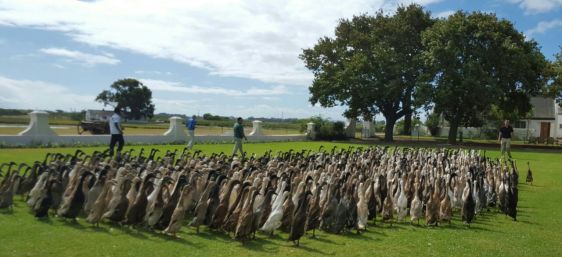
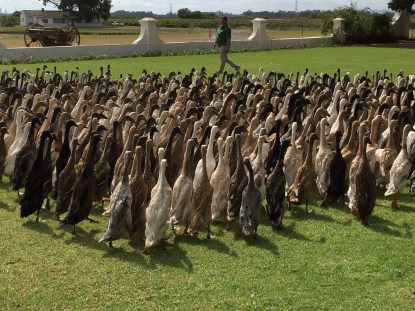
About 30 minutes into our blending experience, we are ushered out of the manor house and onto the lawn. The distant sound of quacking grows louder until we can hardly hear each other. Puzzled searching reveals a flock of about 1 000 Indian Runner Ducks determinedly waddling from the direction of the dam. The ducks, which are domesticated, stand erect and, like penguins, cannot fly.

Herded by a man in the back and a woman in the front, almost as if they are in an invisible enclosure, moving as one unit, the ducks make their way past us, leaving a trail of small feathers in their wake.

One slightly dishevelled duck tries to make a beeline back to the dam, but jumps back into line, after his path is blocked.
file_000-3
The Indian Runner Ducks parade through Vergenoegd wine estate. PHOTO: Saarah Survé

The wine estate uses the ducks to help with natural snail and pest-control in their vineyards. The estate has been refining this practice since 1984.

The ducks work on alternate days and are herded back and forth from the dam or vineyards to their enclosure in the morning and evening.
file_000-4
The Indian Runner Ducks parade through Vergenoegd wine estate. PHOTO: Saarah Survé

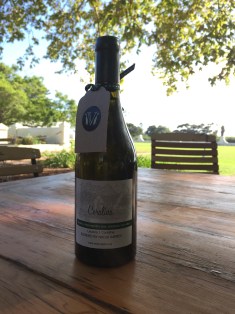
Then back to the coffee blending. If you enjoy the blend of coffee, tea, olive oil or wine that you make, it will be packaged and personalised for you to take home. You can even re-order your blend in the future, because every custom blend is stored in the Vergenoegd library.
file_002
Here is a custom belnd of olive oil which has been packaged and personalised . PHOTO: Saarah Survé

According to their website, every Saturday the wine estate hosts a market from 10am to 4pm. In the summer months they host outdoor movie nights under the stars.

If you still aren’t convinced that Vergenoegd is the place to spend a lazy day, for the series aficionados, the television show Black Sails was partially filmed at Vergenoegd.

2016-02-20-15-30-59
The Cape-Dutch manor house at Vergenoegd wine estate. PHOTO: Mary Lamontagne

Here is a link to Vergenoegd’s website: http://vergenoegd.co.za/

Maties confident about reaching Varsity Cup finals

21 September 2016

Stellenbosch – Stellenbosch University’s netball team have won the last three rounds of the Varsity Cup season and Coach Christine Behan believes they can make it to the finals.

“I definitely believe we will make the semis as we should finish in the top four, but whether we go all the way to finals again depends on who and where we play the semis. That is our goal though and I believe we can do it. We have a great team and if our shooters are accurate, we are hard to beat,” said Behan.

Maties scored five consecutive goals within the first two minutes of Monday’s game against the University of Cape Town (UCT). Behan said it was their goal to lead 5-0 and start strong. Maties beat UCT 69-25.

Captain Juline Rossouw (24) attributes Monday’s success to sticking to the game plan. “It’s something that we have struggled with in the last few games. It was great getting it right in front of our home crowd. It’s very important to make a statement on court from the start. Nobody wants to start on the back foot.”

14364673_1402971049731857_2651218300107648304_n
Juline Rossouw (left), captain of the Maties netball team, in action during Monday’s game against UCT.                        PHOTO: provided by Juline, taken by Stefan Stander photography.

Maties will play the Vaal University of Technology (VUT) on Monday 26 September at 18:00 at Coetzenburg Indoor Centre.

“This will be a very important game for us to get up our scoring average, which might count in our favour going forward in this competition,” said Rossouw, who plays goal defence.

She added that the game against VUT will be a good opportunity to showcase some of the team’s younger players.

Behan said that the team will use the game to practise combinations that they want to use against the University of the Free State.

Maties play Kovsies on Thursday 29 September at Coetzenburg Indoor Centre.

“It will be our most difficult match, because that result will determine where we finish on the log and who we will play in the semi-finals. It’s a very important and a crucial match for us. We are still hoping for a home semi-final too,” said Behan.

North-West University’s Pukke beat Maties 50-37 in 2015’s final. Despite this, Behan has made minimal strategic changes this year.

“Once we know who we will play in the semis we will analyse that team and train according to our specific game plan for that specific match.”

Pityana reflects on legacy of Biko and black consciousness

13 September 2016

Stellenbosch University – Professor Nyameko Barney Pityana (71), professor emeritus of law at the University of South Africa and president of the convocation at the University of Cape Town, said South Africa is missing out on a society of intellectuals and the promotion of a thinking society, without black consciousness.

“Why is it that there is so much interest at an intellectual level in Steve Biko, but very little evidence in society in general and public life of his influence?” asked Pityana, as he addressed students and staff at Stellenbosch University (SU) on Tuesday, the day after the anniversary of Steve Biko’s death.

Pityana was a founding member of the South African Students’ Organisation and an important figure in the Black Consciousness Movement with Biko.

Pityana said that he wished black consciousness was becoming a tool for conversation and for understanding South African society today. “I wish it was a tool for framing much of what we are doing in South Africa today, for framing the new humanity which we are pursuing and what our constitution is actually about, for recognising that there is no future in the unequal society that we are today. There is no future in a society that has large numbers of poor people. There is no humanity in a society that is racist.”

Pityana said that neo-colonialism, neoliberalism, individualism and greed have destroyed the humanity of South Africans.

“The current government of the African National Congress lacks an intellectual frame in which it can move South Africa forward,” said Pityana, who, in an open letter written in 2013, asked President Jacob Zuma to resign.

“Black consciousness could affect leadership and values. It would provide leadership with tools for assessing what the appropriate values that we need in our society are.”

Pityana noted that there is “a growing influence and articulation of black consciousness, a growing readiness on the lips of many, particularly young people and scholars, and a growing number of studies that are being done on Steve around the world.”

Biko’s grandson, Avela Biko (19), who is in his first year of a Bachelor of Arts degree at SU, was also in attendance. He said that, as a young South African, it was overwhelming growing up with the knowledge that Steve Biko was his grandfather. “I never got the chance to meet him. It was always hard to hear things about him, but it’s been a pleasure growing up, getting more information and getting to know him. It’s a privilege to be his grandson, because he did a lot for the country and his influence is still felt today.”

See more of Pityana’s presentation below:

Now is the time for white people to listen and learn

Monday, 15 August 2016

Saarah Survé

Stellenbosch University – Mary Maria Burton (76), former president of the Black Sash and a commissioner on the Truth and Reconciliation Commission (TRC), said that it is time for white people in South Africa to listen to and learn from black people.

Burton made this comment when she addressed honours students from Stellenbosch University’s journalism department.

“I said that it’s time for whites to shut up,” said Burton referring to a recent interview. “I think what I meant is that even today we tend to have opinions and speak them, especially those of us who were opposed to the previous government and were accustomed to fighting for a space. I think it’s time to listen, more than talk. It’s time to learn, more than teach.”

Zenariah Barends, head of investigations for the TRC in the Western Cape, worked closely with Mary Burton during the TRC process. Barends spoke about Burton with great admiration. “She was amazing, a wise woman who I had an incredible amount of respect for. She was never arrogant or boastful. She was very mild-mannered. She always listened. She was someone that you felt you could actually talk to. ”

Barends agreed that those who have benefitted from apartheid need to listen and not be defensive. “They should in fact heed to the words of someone like Mary Burton.”

Burton explained that South Africa’s western bias does not allow for a diversity of opinions and ways of settling disputes that are traditionally available in South Africa. “It does not leave space for learning from one another.”

Although Burton said that the Black Consciousness Movement isolated the Black Sash, her sentiments are not in opposition to what Steve Biko, the founder of the movement, expressed in his book, I Write What I Like.

Biko was against the “superior-inferior, white-black” divide that made the white person a teacher and the black person a student. Biko was also “against the fact that a settler minority should impose an entire system of values on an indigenous people”.

Allister Sparks, in his book The Mind of South Africa, wrote that Biko believed in the primary necessity of “blacks to emancipate themselves” so that “they could deal with whites on equal terms in their own minds: otherwise the inequality would continue, with whites calling the tune and the blacks following submissively”.

Burton alluded to this when she asked: “Can we sufficiently sit back and not say ‘yes, but…’ when people tell us things?” She said that South Africans have a fantastic opportunity ahead of them if they learn to listen.

“I see signs of great courage among young people now, whose parents were exhausted and also felt that they could not betray the cause by criticising their leaders,” said Burton. “I think that has changed and I hope that we have not left it too late and that this next generation is going to bring about the change.”

De Villiers reflects on challenging year at SU

Monday, 1 August 2016

Saarah Survé

Stellenbosch University – In just one year at Stellenbosch University (SU), the vice-chancellor, Professor Wim de Villiers, has experienced five of the six main areas of student protests.

These  include tuition, rape culture, black lives matter, decolonisation of the university and outsourcing and insourcing.

“I didn’t know what I was signing up for when I became vice-chancellor,” said De Villiers, as he addressed honours students from SU’s journalism department. “There is no textbook on how to handle student protests.”

De Villiers, who started his new position on 1 April 2015, said that his time at SU has been complex and challenging, but very rewarding. He joked with the students that perhaps he should not have started on April fool’s day.

De Villiers, who is a doctor, said that his background in medicine helps him to deal with the complex issues that he faces at SU.

prof-wim-de-villiers-addresses-su-students-1
Prof Wim de Villiers addresses SU journalism students PHOTO: Saarah Survé

At one stage last year, De Villiers had to stop using social media, because of a hashtag that was making the rounds (#WimdeVilliersmustdie). He said that such a hashtag does not promote useful discussions, but that he is willing to engage with students.

When asked about transformation at SU, he responded by saying that “transformation is a complex issue”. He also said that transformation is a word which has lost all meaning. De Villiers does believe, however, that the university is being transformed.

De Villiers also addressed the issue of fee increases. Although De Villiers noted that students have been fairly quiet at the university lately, he is aware that an increase in tuition, which is inevitable, could spark more protests. “We cannot afford free education for all. As a country, we are not economically developed enough.”

De Villiers said that a sustainable university needs fee increases, but alluded to the poor being exploited in the event of no increase. “All that a 0% fee increase means is that the rich get a massive bargain and the poor suffer… It’s a perverse system.”

prof-wim-de-villiers-addresses-su-students-2
Prof Wim de Villiers addresses SU journalism students PHOTO: Saarah Survé

De Villiers’ advice to his successor would be to communicate. He said that whenever he thought he had communicated enough, he realised that he had not.

From Pollsmoor to a parking lot: the story of Attie van der Merwe

“If you forget my name, just think of Tolla van der Merwe, but I’m just Arthur van der Merwe… you can call me Attie.”

3 August 2016

Janie Du Plessis and Saarah Survé

Another lost soul forgotten by society and left to wander the streets of Stellenbosch. To passers-by he is invisible. Nobody stops to talk to him.

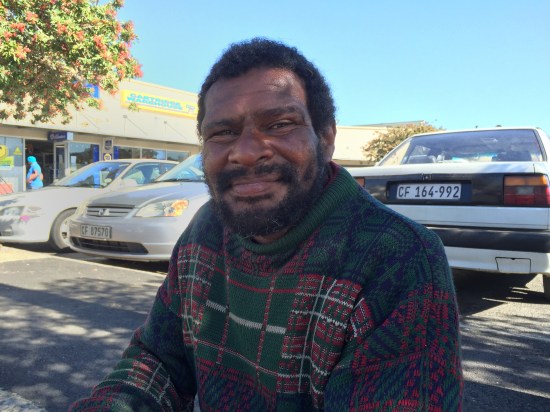
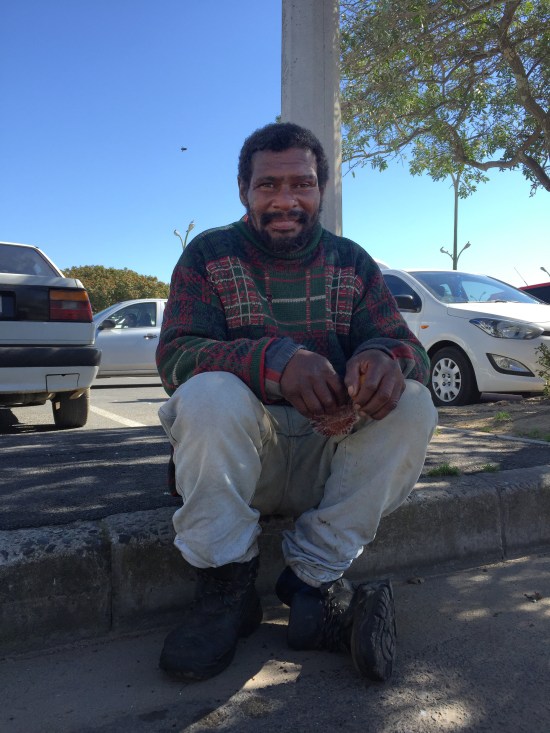
Arthur Nico van der Merwe, 45, sits with his legs spread out in the middle of a parking lot in Andringa Street in Stellenbosch. He is staring at his hands. His left ankle looks twisted as it lies at an odd angle, his foot peeking out of his black, broken boot. The rubber soles have detached themselves from the boot and his black and white laces are untied.

He sighs audibly. “I’m not having a good day. I’m so hungry.”

He has permanent frown lines which have been etched onto his forehead. But his eyes are sparkling and his kind face is covered by a black beard, peppered with grey hairs. His two front teeth are missing.

IMG_5107
Arthur van der Merwe waits for his brother in a parking lot in Andringa Street.      Photo: Saarah Survé

Arthur was released from Pollsmoor Maximum Security Prison in Cape Town two days ago, after one year as an inmate.

“God put me in jail. I had to go to prison, because I broke the law. I did the things that I must do.” He pauses, but does not explain further.

“I’m sitting here waiting for Edward, my brother. He is supposed to pick me up today. He didn’t come yesterday, but I know he will come today.”

Arthur stares at his hands again. His fingernails are long and sharp. Black dirt has built up underneath them. They look like they could be used as a weapon. His hands are scarred and caked with brown dirt. He holds tightly onto the chocolate muffin in his hand.

“As long as I am out of prison, I’m happy. Pollsmoor is a horrible place. It is so boring there, there is nothing to do,” he says.

Arthur used to work at a tyre-swop company in Cloetesville before going to Pollsmoor. Now he works at Stellenbosch Provincial Hospital where he washes the hospital’s cars.

Before taking a bite of his muffin, he says: “I have to work at the hospital, because I have to make money. When I have money, I can buy food.”

Little crumbs of muffin get stuck in his beard and more fall to the ground. When he takes the last bite, he wipes his fingers onto his faded blue jeans already dusted with dirt.

“Most of the time I buy food, but sometimes I buy wine. Wine makes me warm when I sleep and it makes my chest feel better,” he says, as he pretends to drink from an imaginary bottle.

His dark green and red jersey appears to be too big. Threads hang off the jersey and there’s a hole in the fabric in the middle of his chest.

“In the winter it’s not nice here. When it rains I sit in this parking lot. I sit in the rain, but I pretend like I don’t get wet and cold, because there is nothing I can do about it.”

He rolls the letter “r” when he speaks and speaks comfortably in both English and Afrikaans. He switches between the two with ease.

IMG_5108
Arthur van der Merwe waits for his brother in a parking lot in Andringa Street.      Photo: Saarah Survé

“You know, the devil got in me… He told me to take my wife away… I buried her myself.”

Arthur suddenly cringes at this thought and twists his foot all the way out of his shoe.

“I did what I had to do; I took her away because she made love to my brother. I told my brother as well, I told Johan that I will kill him too.”

It seems like the betrayal by his wife, Synobia, still bothers him today. “I married her for life. My brother sleeps around with lots of women, he could have left mine alone,” he says, looking away.

“Anyway, I have a new woman now.” The sudden change in subject indicates that he is finished talking about Synobia.

For the past two nights, Arthur has slept in the doorways of local shops.

“The police won’t chase us away when we sleep there, they want to help us,” he says.

Even though the police do not bother Arthur, it’s the way other people treat him that troubles him most.

“Some people look at me in a funny way, but then they just walk past. They don’t ask questions and they don’t give answers. But if they want to be like that, it’s better that they stay away. Then the devil also stays away.”

Arthur thinks to himself and plays with the muffin paper in his hand.

“If you forget my name, just think of Tolla van der Merwe, but I’m just Arthur van der Merwe… you can call me Attie.”

Tinder – a cautionary tale

“I nearly spent the night in prison, because of a date with a guy I met on Tinder.”

Yes, you read that correctly.

Amy Clarke* (23), a former Tinder-user, experienced a crazy second date in August last year.

How it started…

Amy says that she downloaded Tinder, the online dating application, because she wanted to find out how digital communication affects social relationships and emotional attachments.

Amy, an art student at Stellenbosch University, had been chatting to her date for about a week, when they decided to meet. On their first date Harry* was the perfect gentleman.

“I actually quite liked him. He was very kind and sweet. But now I realise why he was so nice.”

File_000

It was a match for Amy & Harry.  Photo: Saarah Survé

She wanted to see him again

After working a night-shift at a bar, Amy decided to tag along with Harry, who needed to deliver a parcel to Cape Town International Airport, for an early morning flight to Johannesburg.

“We planned to have a coffee at the Woolworths café.”

Something wasn’t right

“I waited in the car at the cargo freight area, while Harry went inside. I couldn’t put my finger on it, but something fishy was going on,” Amy explains.

“I realised that I had gotten myself into a huge f***ing mess, when Harry returned to the car with the police and sniffer dogs.”

They searched the vehicle and apparently found something suspicious. “I was immediately separated from him and escorted to a small office space by a female police officer, where I was interrogated,” Amy says. 

Harry’s parcel contained cocaine.

Amy thinks that the police officer took pity on her.

“I think that she saw me as an innocent bystander, after I showed her the Tinder chat messages between Harry and myself and she believed me.”

Amy was let go without being charged. She does not know what happened to Harry. He never messaged her again.

Would she still recommend Tinder?

Yes, despite her experience.

“I think that it’s a great way for people who struggle socially to find company. The concept of technology as a way of connecting should not be shamed.”

Any tips for new users?

Her advice is to be safe and smart, and learn from her story. (See below for 10 more Tinder tips)

*Names were changed to protect identity.

Perhaps after reading this story, you’ve decided that Tinder is not for you. The non-Tinder-users in the video below would agree. Hear them explain what the app is in their own words, and why they’re not using it.

Top 10 Tinder Tips from 5 Tinder users:

  1. Don’t take Tinder too seriously – have fun!
  2. Make your photos count. Don’t post gym pictures or selfies – too many will make you look vain.
  3. Don’t believe everything that someone tells you, because they will tell you anything to get you to go on a date with them.
  4. Be honest, because lying on an online platform won’t get you far.
  5. Try a different opening line. Change “Hi, how are you?” to something smart or witty, that they’ll remember.
  6. Write something in your Tinder biography, because that could be the difference between a like and a pass. Be grammatically correct – it tells a lot about you.
  7. Be ruthless – don’t talk to everyone.
  8. Skype beforehand, so that you can see who they are before you decide to meet in person. Make sure you meet in a public place.
  9. Be yourself.
  10. Be safe and be smart. Tell a relative or friend that you’re going to meet someone.

Swipe right for love?

How Tinder has changed the dating game 

Catherine Paulse (20), a UCT student, had been single for a year, when her best friend dared her to download Tinder, if she didn’t meet a man in a week. In fact, Catherine’s friend, Jessica*, met her current boyfriend on Tinder.

Throughout the year that she used the app, Catherine experienced the good and bad that Tinder has to offer.

“I’ve never been into dating sites, but I thought that it would be a cool way to meet people and look at hot guys. I found the app to be fun more than anything else. I didn’t take it too seriously,” said Catherine.

Tinder is an easy-to-use online dating application (app) that was founded in 2012. It uses your phone’s global positioning system (GPS) to find other Tinder users in your area. They can see your profile, which includes six photos from Facebook, your name, age and any pages you’ve “liked” on Facebook. If they like you, they’ll swipe right, if not, they’ll swipe left. If both of you have swiped right, you’ll match and be able to message each other.

Tinder works on the basis of finding someone attractive at first glance and quickly deciding if you are interested, while bearing in mind that you are only allowed a certain amount of likes per day.

According to CNBC, an estimated 50 million people signed up to use the app last year, but Tinder will not disclose exact figures.   

According to Tinder’s website, the app is available in 196 countries – there are 1.4 billion swipes per day, 26 million matches per day, and more than ten billion total matches. On the website there is a page dedicated to Tinder success stories, for couples who met “the one” through the app.     

According to Fast Company magazine, Tinder has 9.6 million daily active users and connections on the app lead to 1.3 million dates per week.

On average users log onto Tinder 11 times a day, according to an article on The New York Times’ website. Women spend as much as 8.5 minutes swiping left and right during a single session, while men spend 7.2 minutes, which can add up to 90 minutes each day.

According to Wired magazine, “42 percent of people using Tinder are already in relationships—and many of them are men”. Furthermore, according to Global Web Index’s 2015 study, 30% of Tinder users are married.

Tinder has a reputation for being used to engage in casual sex, hook-up or have a one-night-stand, but a recent study done by Tinder found that 80% of users want more than a one-night-stand.

James Thompson* (22), a former Tinder-user, would go on and off Tinder for a few days and then delete the app, because he was not sure whether he wanted to be associated with the stigma of being on Tinder. This is also the reason he wanted to remain anonymous.  

Tinder president, co-founder and returning CEO Sean Rad suggested that Tinder is more of a “social discovery app” than a dating app to facilitate romantic connections.

During an interview with Fast Company magazine, Rad claimed that his vision for Tinder is much bigger than just a dating app. He has plans to build Tinder into a robust advertising vehicle and subscription service.

In March last year, Tinder released Tinder Plus, which comes at a cost (about R140 per month and almost R300 for over 30’s), but has more features. New features include the ability to change your location when you travel to connect with people around the world, unlimited likes and a rewind button for accidental swiping.  

Rad had no problem justifying the price of the app. “How much would you pay me to meet your [future] wife? Ten thousand dollars? Twenty thousand dollars? Some people would probably give me their entire net worth.”

On the website’s description, it says that Tinder “empowers users around the world to create new connections that otherwise might never have been possible. We build products that bring people together”.

Dr Wendy Walsh, an American psychologist who specialises in attachment and human mating strategies, said that “biology trumps psychology”, meaning that men focus on beauty first and foremost, which is what Tinder allows them to do.

Walsh, who is also known as America’s relationship expert, said that Tinder is based on male mating strategies, because of the way that it works, with photos and only a short biography.

According to Walsh, women are searching for “resources, intelligence and kindness, which can be harder to convey on Tinder”. Therefore, Walsh advised men to put as much thought into the backgrounds of their photos, as they do the actual picture of themselves.  

“Women are looking for status indicators. They don’t care about your abs, unless they only want a hook-up. They are looking to see where that lamp behind you is from,” said Walsh.

According to James,  he will not recommend the app to his female friends, because “guys just ask for sex or nude pictures, or even send nudes”.

James joined Tinder to meet new people and possibly go on a few dates. He has been on three.

On one date, he met a girl on campus in between lectures. “That fizzled out, because she wasn’t the same offline (face to face) as she was online. I worked that out very quickly.”

“It’s a common thing when you have a connection with someone on the phone, because you’re texting and have time to think about everything you say, but when you’re face to face, you don’t have that same luxury.”  

James said that his worst experience was meeting someone who did not look like their picture on Tinder.

James prefers Tinder to meeting people in real life. “I like that you’re meeting people you wouldn’t normally chat to and that they come from a different background or walk of life.”

Before Catherine started using Tinder, she never made an effort to meet new people. “If people came into my life randomly, then I thought that they were probably supposed to be there, instead of swiping across my phone screen to meet people.”

Although she would recommend Tinder to her friends, Catherine said that not all of her experiences on the app have been positive.

“A guy started harassing me on Tinder, he kept sending me ridiculous messages asking for nude pictures and if I would sleep with him, but I refused to respond. He persisted.” She unmatched him (blocked him) and wanted to delete the app.

However, before she deleted the app, she started messaging someone promising.

“We’ve been chatting for a month now, but we haven’t met in person. He’s a really nice guy, and we actually have mutual friends. I’m seeing where that could go.”

Catherine believes that Tinder and social media in general have completely changed the way her generation dates.

“I look at how my parents dated and how young people date today. Social media has created more drama in dating. I think that’s one of the main reasons that our relationships don’t last. It opens up these doors where cheating can occur and miscommunication happens. Our generation obsesses over social media through stalking our partners, or girls and guys that we think that they are hooking up with.

“Then I look at my parents and I really believe that the lack of social media meant that they didn’t have those sorts of problems, because they had to talk about their issues, rather than sending passive aggressive messages over WhatsApp.”  

*Names were changed to protect identity. Catherine did not mind.

Does appetite loss help your body to cope?

Why do people often lose their appetites when they are ill?

13 April 2016

Saarah Survé, Stellenbosch Department of Journalism

Stellenbosch – Winter is around the corner and with the seasons changing, more people tend to get sick. But why do people often lose their appetites when they are ill?

Dr Ferial Abdurahman, an obstetrician and gynaecologist at Wynberg Military Hospital, said that the reasons for appetite loss vary, depending on what kind of illness a person has.

“When you are sick your brain releases chemicals called cytokines and these decrease your appetite. Your body receives the message to conserve energy. Sometimes hormones can also play a role,” said Abdurahman.

“Most of the time when you are ill, your body wants to conserve energy to fight the infection, rather than use that energy to digest food. Your body fights the infection with an army of white blood cells (or fighting cells) that multiply and are sent to each organ and into your blood,” Abdurahman explained.

Dr Ramona Stewart, a retired general practitioner, agreed. “Losing your appetite when you are ill gives your body more time and energy to fight off the virus.”

Abdurahman explained how different illnesses cause appetite loss. “The flu affects the entire body, even if it can only be felt in the head and chest. If you have sinusitis or a cold then it is likely that you will have impaired smell and taste, which means that you may not want to eat your food, because you can’t smell it. Alternatively, if you have gastroenteritis (gastro), you lose your appetite because you feel so sick from vomiting and diarrhoea.”

Stewart recommended that sick people who lose their appetites should rest, keep themselves hydrated (drink water or electrolyte solutions) and eat foods like soup, smoothies and yoghurt only when hungry.

“Snack regularly on foods that don’t take a lot of effort to eat, and listen to your body. If you are suffering from severe dehydration, which can occur when you have gastro, and your body is not responding to your attempts to rehydrate orally, you may need intravenous fluids. Then you should visit your doctor.”

Stewart advised against eating sugary foods. “When someone we know is in the hospital, our first instinct is to take them chocolate or sweets, but glucose helps the bacteria to flourish. If you’re eating less, the bacteria won’t find glucose and iron to feed on.”

Abdurahman explained why many people are getting sick at the moment. “Our bodies find it very difficult to adapt because the seasons are changing. The body has to adapt to a cold temperature after being in a hot one.”

Stewart added that another factor is that people stay indoors when it is cold, making it easier for the virus to spread from one person to another.

“At the end of the day, it’s about the body’s resistance. If your immune system isn’t strong enough and your resistance is low, you are more susceptible to sickness. Our bodies need to absorb a balanced amount of vitamins and minerals from our food. The quality of the food you are eating is more important than the amount you are eating,” said Abdurahman.

Waterfall – a descriptive piece

Saarah Survé, Stellenbosch Department of Journalism

Nicholas has bags underneath his eyes even though he has just woken up. His unwashed hair and greying beard make him look older than he is. He stretches one muscular arm across the crinkled sheets and onto the empty space beside him. He frowns, confused, and then dismayed realises that it wasn’t a dream. He sits up, unable to go back to sleep. His mouth is parched.

He hears the window panes rattling and the neighbour’s ducks quacking. Brown dried up leaves crack in the wind. Longingly, he looks outside of the window, to another place and time.

Someone is watching a young boy clad in a navy sweater and knitted cap walk carefully through the rustling reeds.

A young girl, wearing a maroon rain jacket, guiltily turns her face downward, as her long, mousy hair blows into her eyes.

A different memory; in the sunshine Nicholas carries his daughter on his back. Her cheeks are flushed pink, and she smiles, her hair out of her pretty, pale face.

A new memory; her brother follows her and together they crunch over the autumn leaves. The wind howls, crickets chirp and somewhere far away chimes ring.

The three of them laugh together, as their father runs a small black lizard between his fingers.

The sun disappears and birds squawk as if they are warning the family of something to come. There is a feeling of unease in the air.

She sees her brother on top of a mossy-green rock, breaking twigs into smaller pieces. She decides to join him. Now it is only the two of them, surrounded by leafless trees, in an abandoned forest. The air is crisp.

Her brother collects small, silver fish. His pudgy fingers pull out each one’s slippery eyeball and then he knocks its head onto a tree trunk. This action causes a pool of blood to congeal on the bark. The smell is overpowering and forms a metal taste in his mouth. He scoops out any leftover goo, and wipes his finger onto the ground. He leaves a gaping hole in the fish’s head.

Their father seems to be consumed in another world as he sits on a rock, throwing bits of reed into the water.

With nobody, besides his sister, watching him the boy defiantly rolls up his jeans, pulls up his socks and ventures into the shallow waters. Balancing on some rocks, he reaches for another fish. Just when his fingers are about to touch the surface, he slips and plunges into the icy cold water, which is much deeper than he expected.

He screams for help as he is submerged, his arms flailing and his legs kicking underneath the water, but all that comes out is bubbles. The water burns his throat and he can’t breathe as it begins to fill his lungs.

His sister looks on paralysed, frozen to her spot. Her lips are blue from the cold and she’s lost her pink glow. Now you can see that she has a little mole on the top of her lip, not noticeable at first glance.

Inspired by the short film, Waterfall, by Charcole. Watch the film here: 

https://vimeo.com/95198897