SU students go wild for natural medicine

30 March 2016

Saarah Survé, Stellenbosch Department of Journalism

Stellenbosch – KeenMind, a natural alternative to medications like Concerta and Ritalin, is flying off the shelves at the Eikestad Mall pharmacy in Stellenbosch, according to Michael du Preez, who supervises the pharmacy’s vitamin laboratory.

KeenMind claims to improve mental performance.

“It is our biggest seller at the moment as more students move towards a more natural option. We recommend it, because students don’t need a script to buy it and it doesn’t cause a crash, like Concerta and Ritalin, which you do need a script for,” said Du Preez, a biochemist.

Du Preez advised students to skip a weekend of partying and invest in their health instead, which will in turn benefit their education, as they will be able to concentrate better.

“In relative terms, these supplements are not expensive; R205 to R250 for a month’s supply is a tiny price to pay for delayed gratification.”

Du Preez said that KeenMind can work as quickly as three to four days. He added that no serious side effects have been recorded.

Du Preez has first-hand experience with Ritalin, as he was prescribed the drug at age 13. He says that it changed his character. “You become subdued. It’s like a tranquiliser.”

Similarly, Jacques Booyens, a Stellenbosch University (SU) graduate, began using Ritalin at the age of eight. He stopped this year and is studying for the first time without any medication.

Booyens admitted to trying a few natural products for focus, but felt like a lot of them were “just snake oil.”

De-Ann Snyders, a Stellenbosch student in industrial engineering, was also diagnosed with ADD and has been on Concerta for two years.

Snyders said that she tried Bio-Strath, a daily herbal nutritional supplement, but that taking the medication became too much administration for someone with ADD. “It took four days to get into my system and I had to take six pills a day. As someone with ADD, I don’t understand why people want this drug so much.”

“It’s also expensive (about R460 for 300 tablets) and made me very agitated. I felt like a zombie,” said Snyders. “If you don’t need it, stay away. It will help anyone concentrate better, but once you realize that it helps, it can become addictive,” she warned.

Du Preez said that it is important for students to know that there are natural options available, like KeenMind, which doesn’t have negative side effects. He asked students to consider these before they take other medications, such as Ritalin and Concerta.

Theatre transports children to magical place

‘Children believe in what you create on stage’

10 March 2016

Saarah Survé, Stellenbosch Department of Journalism

Weltevreden Wine Estate – “When adults see a production, it influences them and they talk about it. But when a child sees one, their whole world changes. You transport them to a magical place.”

Margit Meyer-Rödenbeck, known for her characters Dowwe Dolla and Liewe Heksie, believes that there is magic in children experiencing and engaging with theatre.

“Children believe what you create on stage, as opposed to adults, who create boundaries around themselves. So, it’s wonderful to create and work for children,” said Meyer-Rödenbeck.

File_000
Dean Balie (Watson) and Sne Dladla (Florence) in Florence and Watson and the Sugarbush Mouse PHOTO: Saarah Survé

She explained that in a children’s theatre production, they coax children into engaging by asking them questions, so that they become the problem solvers or another part of the production.

“Children watch TV and computer screens all the time, but that doesn’t teach them to engage.”

She is worried that if we do not continue to educate children in the theatre, we will lose the future generation.

“In this country, I can’t emphasise enough how important it is to get kids into the theatre and make them theatre-goers,” Meyer-Rödenbeck said.

Hanli Brink, Managing Director of Lollos Productions, agrees that there is a definite need for children’s theatre in South Africa.

Lollos is an Afrikaans edutainment show for children, and there will soon be an English version.

“You can watch Barney, but kids can relate more to South African shows where you teach them about our country and facts like the names of the provinces,” says Brink.

“We’ll teach children about eating healthy, but it will be through a song or a dance or another fun way. We have one song called smarties and tamaties, and it says eat your tamaties before you eat your smarties. It’s catchy, so it sticks in their heads. It’s education, but in a fun, memorable way,” said Brink.

Solms-Delta community gets a voice

8 March 2016

Saarah Survé, Stellenbosch Department of Journalism

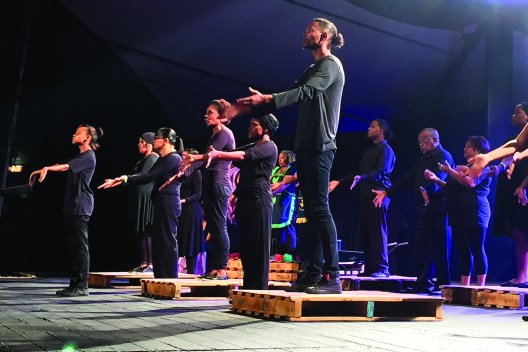
Spier Amphitheatre – The aim of the musical Philida van de Delta is to give a voice to the voiceless and to hear their stories through song.

Philida van de Delta 2
The Delta Soetstemme   PHOTO: Saarah Survé

Organisers of this musical therefore invited members of the Solms-Delta community to take part, giving them a voice in the show.

“Everybody who arrived was allowed to be in the show. Nobody had acted before, but they chose their roles,” said Adriaan Brand, project manager of the Music van de Caab Heritage development. Brand compiled and adapted the story to music. He is also a founding member of the Springbok Nude Girls.

Philida van de Delta
Adriaan Brand having fun on stage  PHOTO: Saarah Survé

Solms-Delta and members of Babylonstoren guest farm and the multidisciplinary cultural Breytenbach Centre collaborated to present Philida van de Delta.

The musical was inspired by historic documents, their own imagination and the late André Brink’s novel, Philida.

“They read Philida, the historical records and had their own ideas. They told their neighbours the story and we actualised their telling of the story,” said Brand. “We gave them complete freedom to express their voices, but with support; sharing information, drama-training and how to project the voice.

“They first performed the show to people in the valley, because they wanted the ‘home-crowd’s’ approval before performing it to outsiders,” said Brand.

The Solms-Delta music project includes the Delta Soetstemme and Delta Langbroek-orkes. As the music project grew amongst the local community, the idea of making a theatre musical came up.

Philida van de Delta
The Delta Soetstemme   PHOTO: Saarah Survé

“Music in the Cape Winelands and Cape folk music in particular, was an organic, self-facilitated process of healing. Historically, songs encoded meaning in a language shared by the owners and slaves,” said Brand.

According to Brand Philida van de Delta is relevant now, because of “the importance of telling stories, especially those pertaining to the era of slavery”. He believes that not enough people are telling their stories during this time of restitution, building a new identity and reappraising South African identities.

“It is particularly poignant, because of a culture of silence. A voice was systematically stolen and people were systematically enslaved,” he explains.

Karina Magdalena Szcurek, the late Brink’s wife, says that “slavery is one of the most important aspects of South African history that has not been explored sufficiently. Philida’s voice is literally reverberating through the centuries, and now it is being heard again through the musical. It says everything about the human spirit, women’s resilience, and the power of storytelling.”

According to Szcurek, while everyone cried, she was the only one who had to leave, sobbing uncontrollably, just after the show. “I am humbled by the experience in all kinds of ways, and grateful. The performance was utterly beautiful in all respects – simply stunning!”